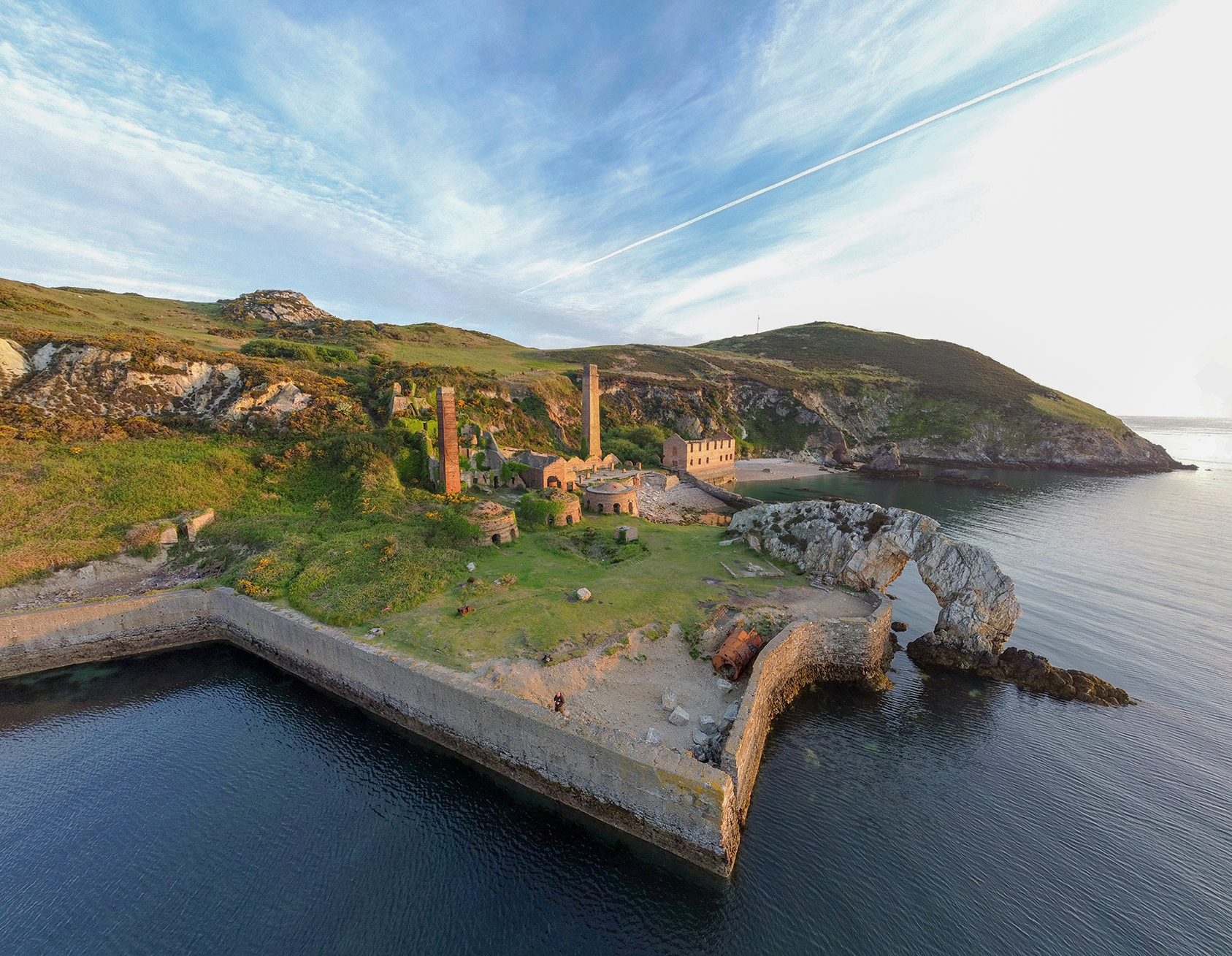
On the wild north coast of Anglesey, where cliffs fall steeply to a slate-coloured sea, the ruins of Porth Wen brickworks cling to the edge of White Bay. Three beehive kilns, half-collapsed chimneys and a shattered quay stand silent above the waves, their red brick stark against green cliffs. Once, this isolated cove was part of a global industrial network, feeding the steel furnaces of Britain and beyond. Today, Porth Wen is one of Wales’s most striking abandoned industrial sites, a scheduled monument and an evocative reminder of how geography, geology and economics can shape – and end – human endeavour.
The Setting: A Remote Bay on the North Anglesey Coast
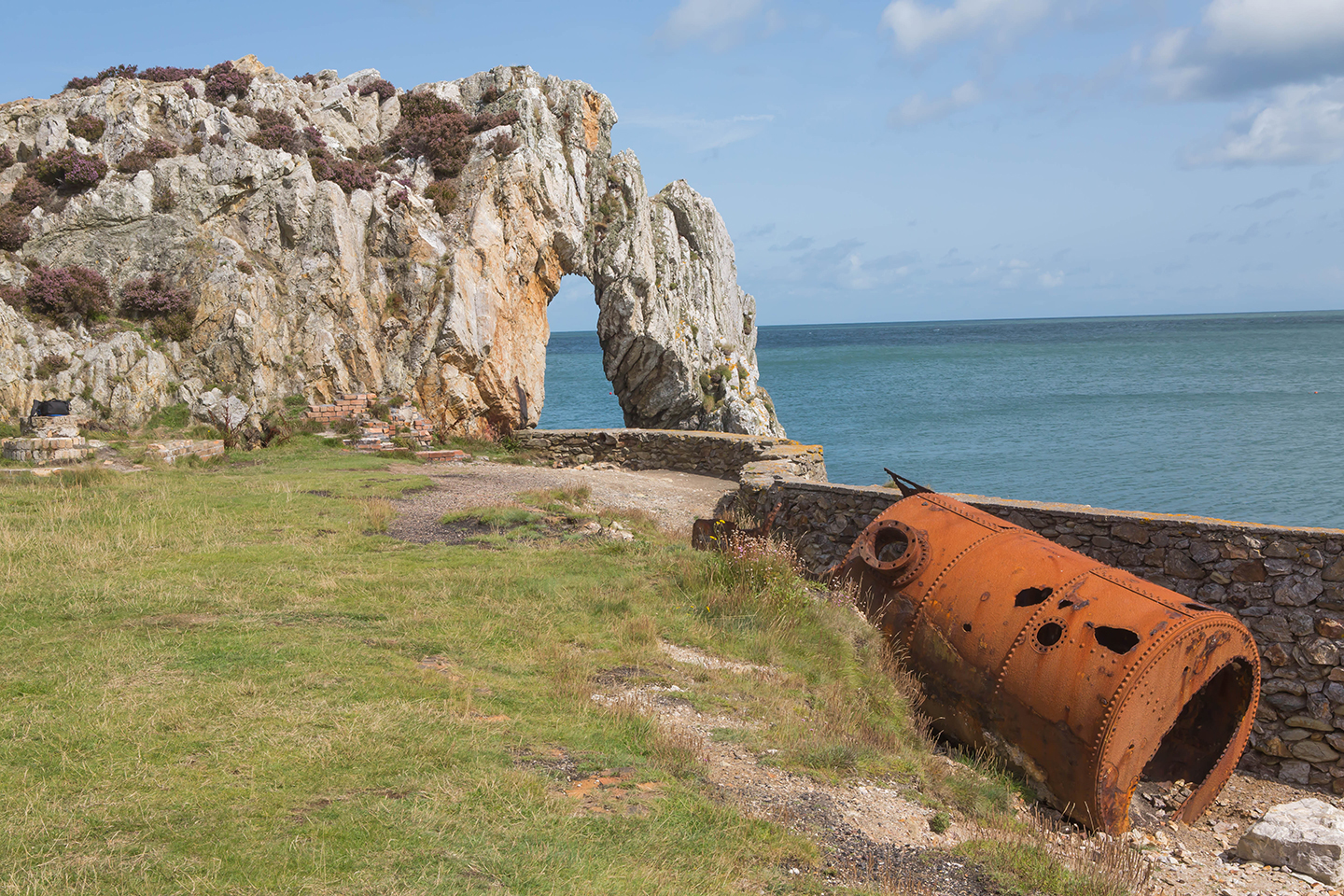
Porth Wen, literally “White Bay”, lies between Bull Bay and Cemaes Bay, in the community of Llanbadrig on the north coast of Anglesey. The brickworks occupies a narrow platform between the steep hillside and the sea on the western side of the bay, which opens northwards into the Irish Sea. The surrounding coastline forms part of the Anglesey Area of Outstanding Natural Beauty, where rugged cliffs, heather-covered slopes and exposed rock outcrops give a sense of remoteness despite the island’s relatively small size.
This is not an obvious place for industry. There is no sheltered harbour, no broad estuary and no easy road access. Yet the cliffs around Porth Wen contain precisely the resource Victorian heavy industry craved: quartzite, a hard, silica-rich rock that could be turned into refractory, or fire, bricks capable of withstanding the intense temperatures of steel furnaces. It was the combination of this geology and the demands of the industrial age that brought the brickmakers here.
Origins of the Brickworks
Brickmaking at Porth Wen began in the mid-nineteenth century, developing from existing quartz quarries on the headland above the bay. Some sources suggest activity as early as around 1850, when ore was first quarried by hand from the cliffs, while others emphasise the 1870s as the period when the site took on the form of a dedicated silica brickworks.
By the turn of the twentieth century, the works were known as the Porth Wen Silica Brick Works. Around 1908 they were owned by Charles E. Tidy, trading as the Tidy Brick and Tile Company, and expanded with more substantial buildings and improved equipment.
The motive behind this investment was clear. As iron and steel production boomed in Britain and abroad, so did the demand for specialist refractory bricks. Ordinary clay bricks would crumble in the fierce heat of an open-hearth or Bessemer furnace. Silica bricks, made largely from quartzite, retained their strength at high temperature and were therefore invaluable for lining furnace interiors. Porth Wen, remote as it was, seemed well positioned to exploit the quartzite beds of north Anglesey and capture a slice of this profitable market.
From Stone to Silica Brick: How Porth Wen Worked
The remains scattered across the site today allow the whole production process to be read in the landscape. Above the works, two small quarries were cut into the quartzite. From here, a gravity-operated incline tramway carried the rock down to the works: small wagons were lowered on one track while the weight helped haul empties back up on the other. At the top of the incline stood a winding house, parts of whose masonry walls and drive shaft survive.
At the foot of the incline, the ore entered the crushing house. Here, large pieces of quartzite were broken down in stages, initially with mechanical knocking or knapping machinery and, at least in earlier periods, by workers using hammers while wearing iron-covered gloves to protect their hands. The aim was to reduce the rock to a fine powder suitable for brickmaking.
The powdered quartzite was mixed with lime and water in a pan mill to form a workable paste. This mixture was then shaped into bricks in the moulding shed. Early on, bricks were probably made using hand moulding and wire cutting, with later improvements introducing mechanical presses to produce more regular and denser bricks. The green, unfired bricks were laid out in drying sheds, where air flow – and sometimes gentle heat – removed much of the moisture.
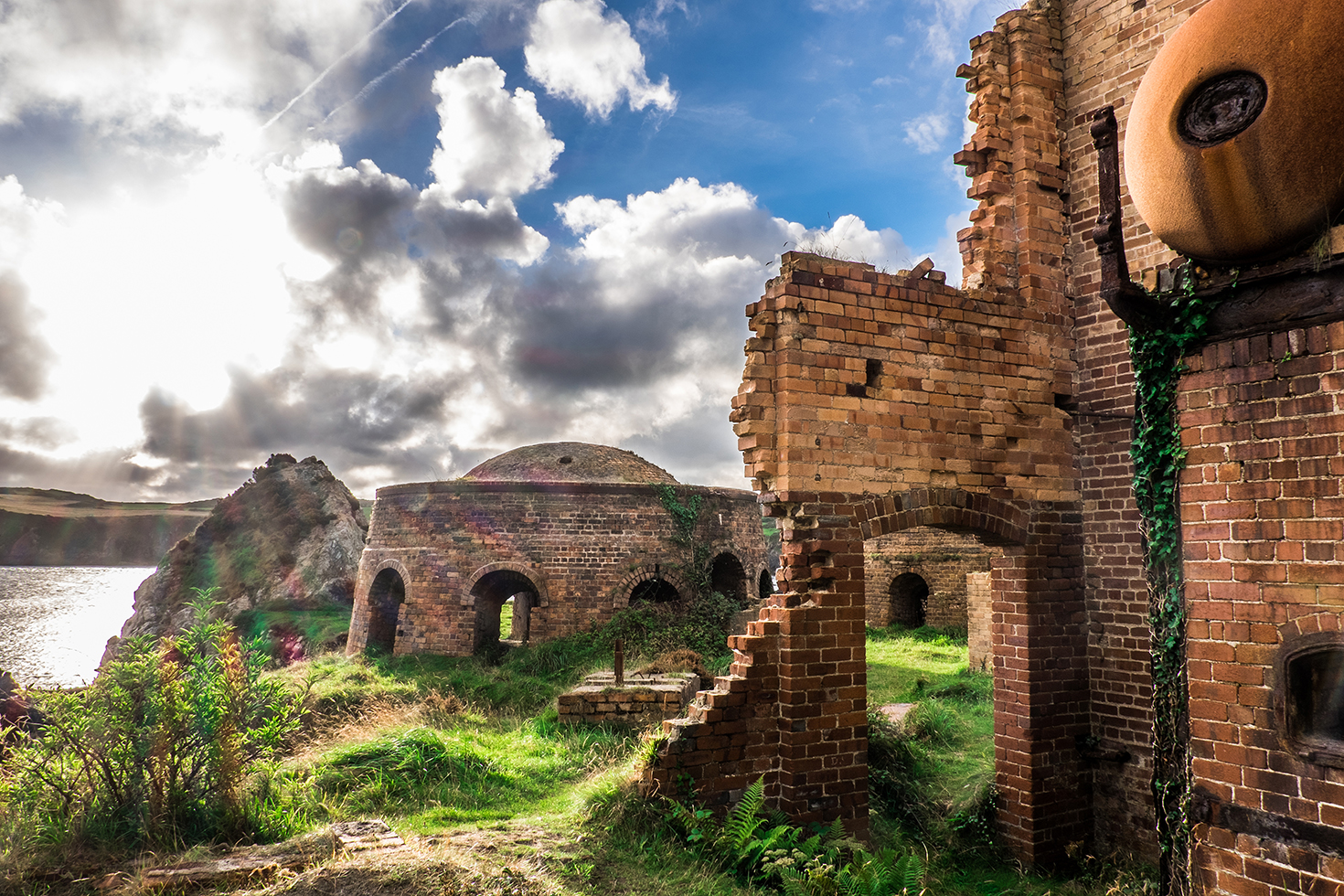
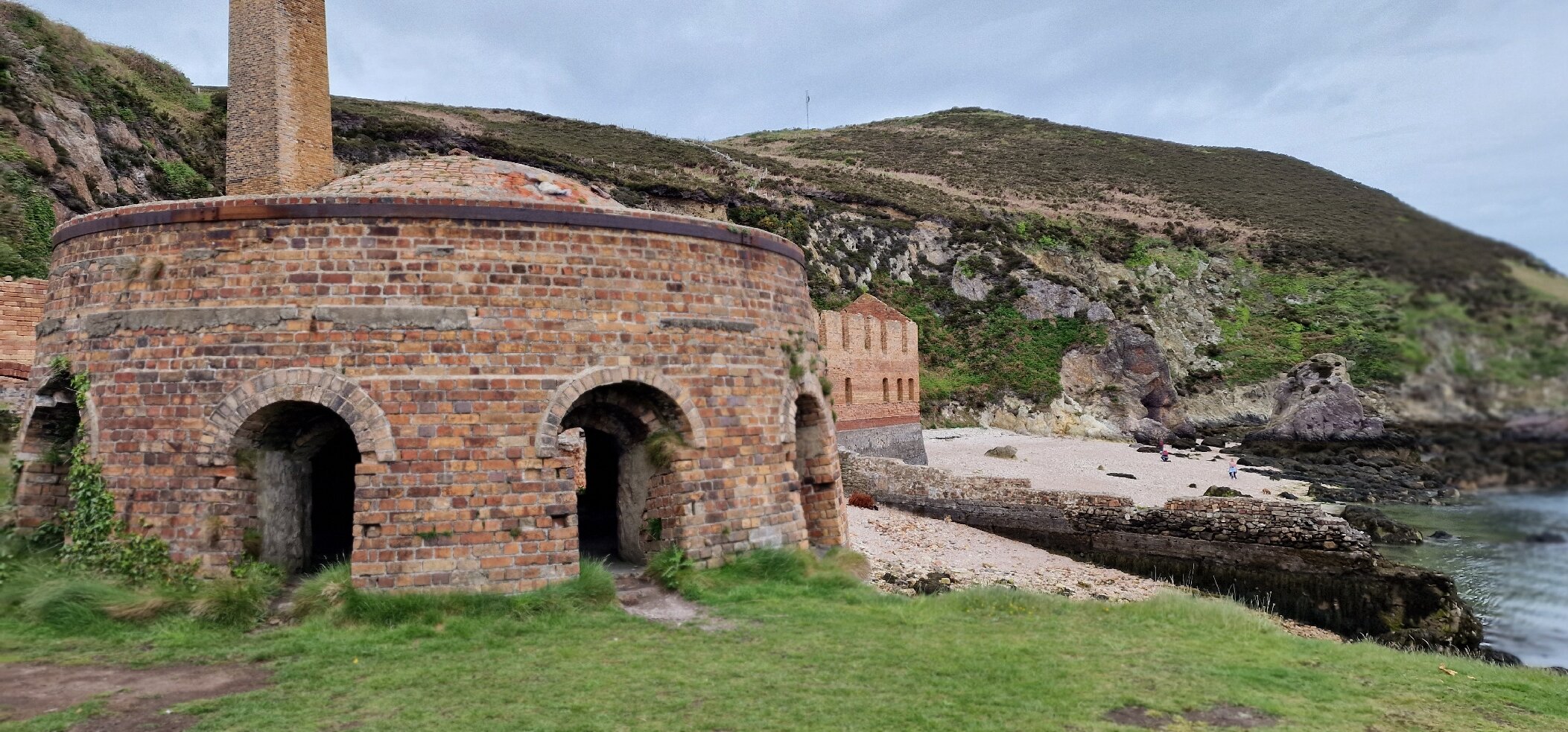
Once dried, the bricks were stacked in the site’s most distinctive structures: three circular down-draught, or “beehive”, kilns. These domed brick kilns, banded with iron rings, were fired from arched openings at the base. Once the fire was established and the kilns sealed, hot gases were drawn down through the stacked bricks, ensuring an even firing. The control of temperature and airflow in such kilns was a skilled job, crucial in producing bricks that would survive the stresses of industrial use.
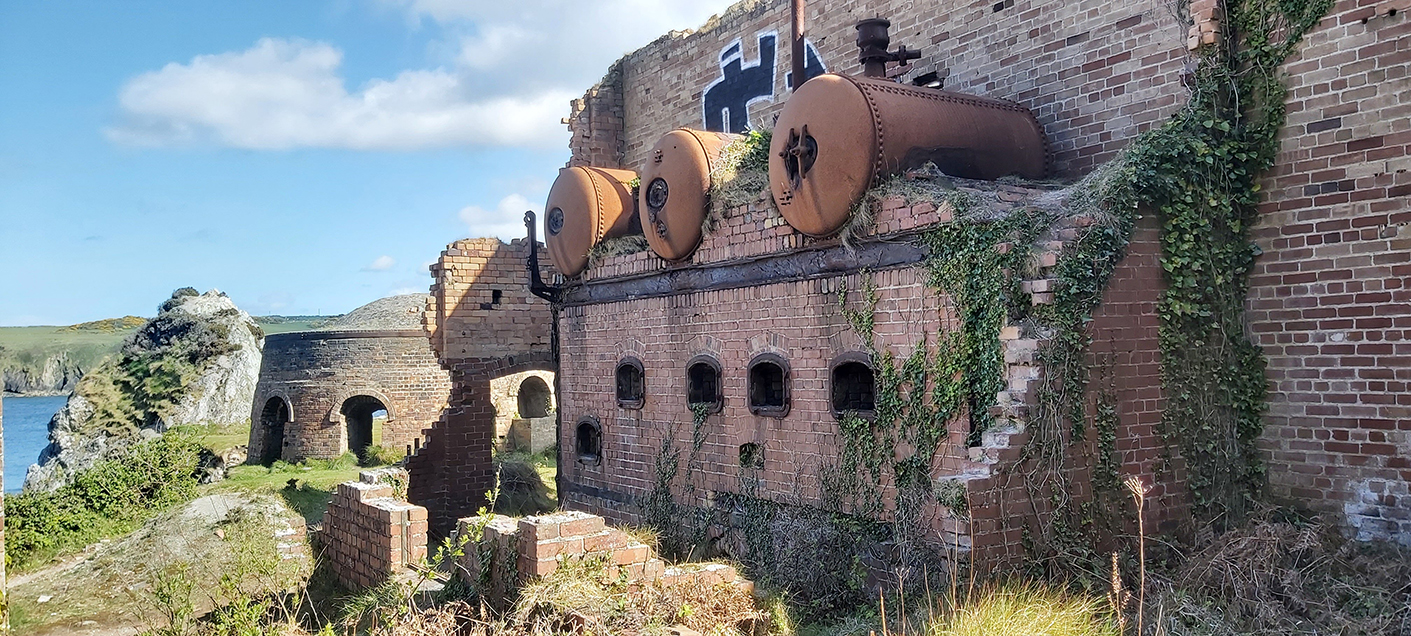
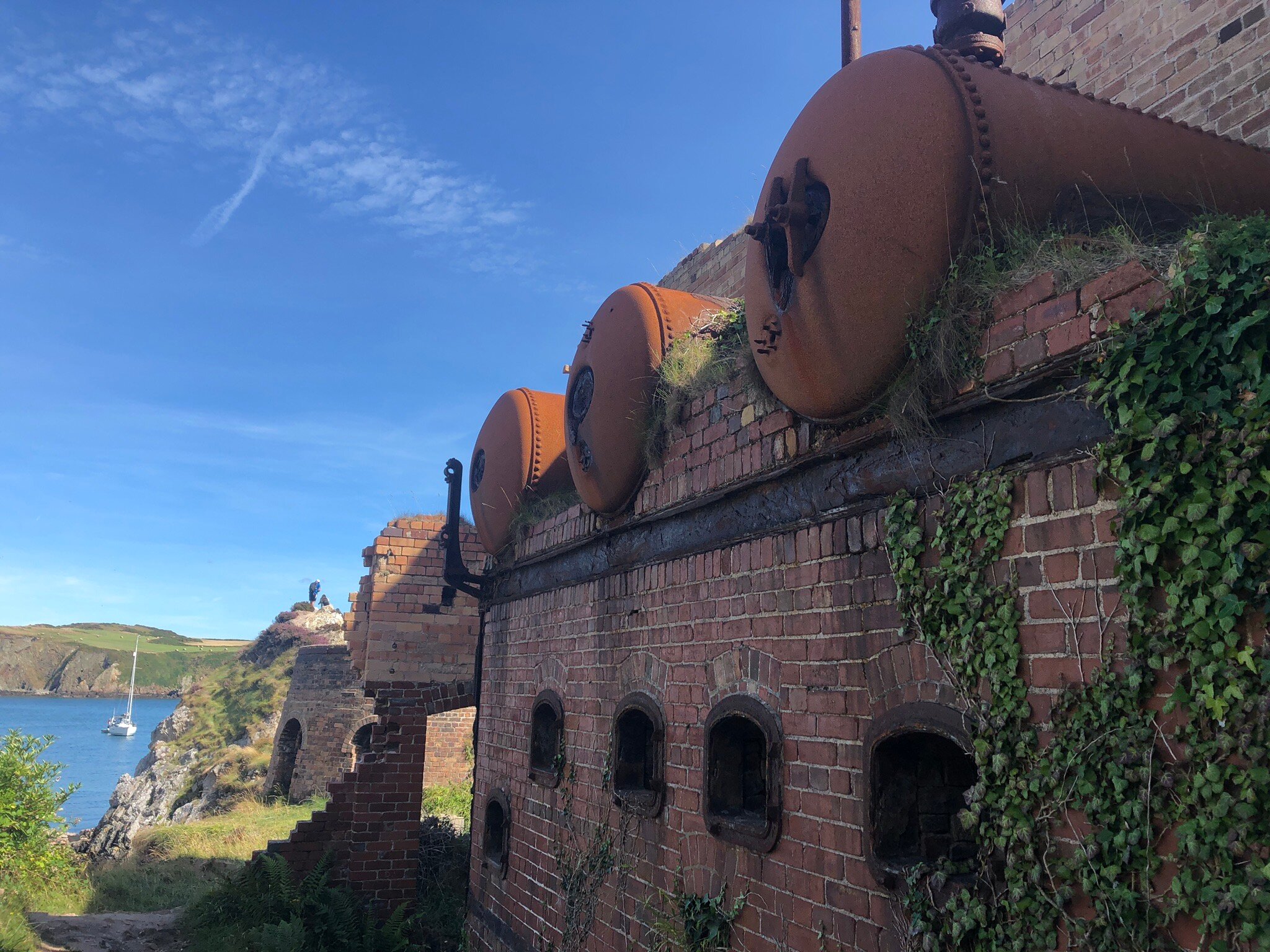
Supporting the kilns and moulding sheds were auxiliary buildings: a boiler house, which once housed a Stirling water-tube boiler; a small engine house for a steam engine; storage hoppers and a two-storey warehouse where finished bricks were stacked ready for shipment. Finally, at the water’s edge, a quay and harbour walls allowed vessels to moor while bricks were loaded aboard by crane.
Life and Labour at the Works
Although detailed records of the workforce at Porth Wen are scarce, the layout of the site hints at a small but busy industrial community. Labour would have been needed in the quarries, at the tramway and crushing house, in the moulding and drying sheds, tending the kilns, and handling cargo at the quay. Many workers likely came from nearby villages such as Cemaes, walking across the fields or along the coastal path to reach the works each day.
The work was physically demanding and sometimes dangerous. Quarrymen faced the risk of rock falls; tramway and crushing machinery could maim the unwary; kiln firers worked in intense heat and smoke. The site’s coastal location added further hazards, with steep paths, slippery surfaces and the ever-present sea below the quay. Contemporary industrial districts on the mainland might have offered urban amenities and stronger unions; Porth Wen’s workforce laboured in comparative isolation at the edge of the Irish Sea.
Yet despite the hardships, the brickworks represented opportunity. The silica-brick industry demanded specialist skills, and a successful works could provide relatively steady employment in an otherwise agricultural area. The presence of substantial buildings and imported machinery suggests that, for a time, there was confidence that Porth Wen could thrive.
Decline, Closure and Abandonment
That confidence proved fragile. The fundamental weakness of Porth Wen was not its geology but its geography. Unlike nearby Amlwch, which developed a safe harbour for exporting copper from Parys Mountain, Porth Wen’s bay offered little shelter. At low tide, jagged rocks emerge below the quay; in bad weather, north-easterly and north-westerly storms can drive heavy seas straight into the cove. Captains were understandably reluctant to risk their vessels for relatively small cargoes of brick, and delays or damage would eat into profits.
As global markets shifted and cheaper refractory bricks became available from elsewhere, Porth Wen’s position became increasingly untenable. Sources differ on the exact closure date: some suggest production ceased in the 1920s, while others argue that operations, perhaps intermittent, continued until about 1949. What is clear is that by the mid-twentieth century the works had fallen silent, leaving buildings, kilns and machinery to decay beside the sea.
In contrast to some industrial sites that were rapidly cleared, Porth Wen was simply abandoned. The remoteness that had made it a problematic place to do business now helped preserve it. With little pressure to redevelop the land, the brickworks slipped gradually into ruin, offering archaeologists and industrial historians an unusually complete – if crumbling – example of a small coastal refractory works.
Ruin and Erosion: The Site Today
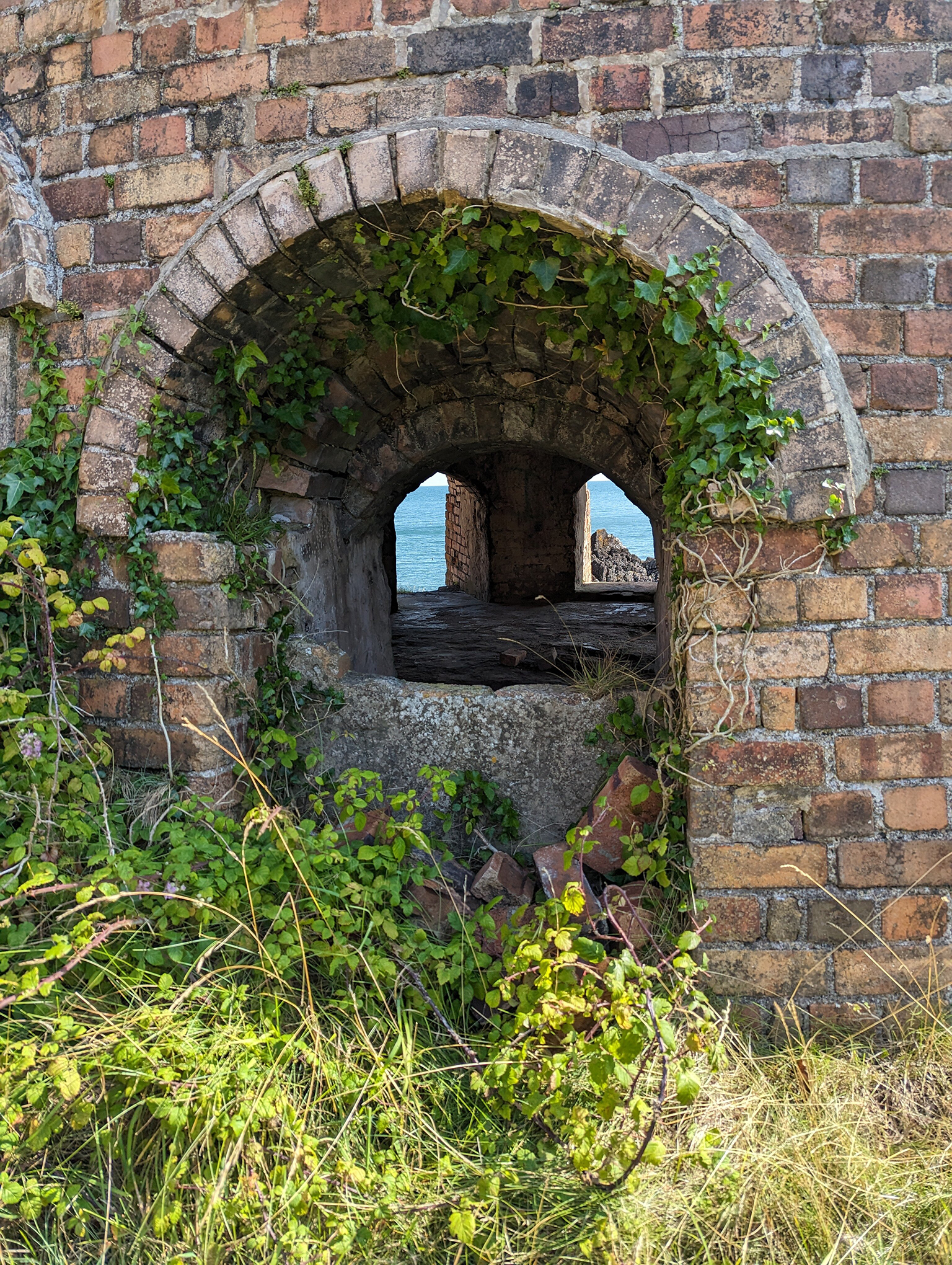
Today, visitors who glimpse Porth Wen from the Anglesey Coastal Path see what looks almost like a stage set: the shells of brick buildings, the three beehive kilns with grass growing from their roofs, and the broken line of the quay extending into the bay. The once-solid structures have been gnawed by time, salt spray and storms. In places, walls bow and lean towards the sea; in others, roofs have collapsed entirely, leaving only jagged gables.
Sea erosion is an ongoing threat. Sections of the quay have been undermined; parts of the harbour wall have collapsed. Waves crash directly against foundations that were never designed to face the full force of the sea without maintenance. At the same time, vegetation is quietly dismantling the works from within, as roots prise apart masonry joints and wind-blown seeds take hold in mortar joints and on kiln crowns.
Despite this, the essential layout of the site remains legible. One can trace the line of the incline, identify the crushing house and moulding shed, and stand beneath the soaring internal domes of the kilns where bricks once glowed white-hot. For many, it is precisely this combination of scenic beauty and industrial ruin that makes Porth Wen so compelling, a place where the nineteenth-century faith in progress meets the relentless forces of nature.
In recognition of its significance, Porth Wen Brickworks was designated a scheduled monument by Cadw, the Welsh Government’s historic environment service, on 27 October 1986. This status acknowledges its value as part of Wales’s post-medieval industrial heritage and gives it legal protection against unregulated change.
Conservation, Access and Controversy
Protection on paper does not automatically resolve practical dilemmas. Porth Wen lies on private land, and the owners have repeatedly indicated that access to the site itself is not permitted, partly because of safety concerns associated with unstable structures and hazardous terrain. Many guides now emphasise that while the Anglesey Coastal Path offers fine views over the bay, descending to the ruins is discouraged or explicitly forbidden.
This situation creates a tension familiar at many abandoned industrial sites. On one hand, there is intense public interest, fuelled by photography, “urbex” (urban exploration) reports and online articles that celebrate the atmosphere of the brickworks. On the other, there is a genuine risk of injury in a place where floors may be undermined, walls unstable and the sea unforgiving. The scheduled monument status adds another layer, requiring that any works – even well-intentioned clearance or stabilisation by visitors – be carefully controlled.
Conservationists face difficult choices. Full restoration would be costly and might diminish the evocative power of the ruins; complete closure and neglect, however, would leave the site to eventual collapse under erosion. For now, the approach has largely been one of minimal intervention, documentation and awareness-raising, while access debates continue among landowners, local authorities and heritage bodies.
Porth Wen in the Wider Story of Welsh Industry
Porth Wen does not stand alone. It forms part of a wider pattern of industrialisation on Anglesey and across north-west Wales. Nearby Parys Mountain was once the world’s largest copper mine; Amlwch grew as its exporting port. Across the region, slate quarries, copper workings and small brickworks transformed the landscape and tied rural communities into global trade networks.
What makes Porth Wen distinctive is its scale and setting. Unlike the vast quarries of Llanberis or the sprawling complexes of south Wales steelworks, this is a relatively compact site, wedged between cliff and sea. It demonstrates how even small, remote coves could become nodes in an industrial world system, contributing specialist materials to industries hundreds of kilometres away.
It also illustrates the vulnerability of such enterprises. Where the great steelworks of south Wales could adapt and survive for decades, a small coastal brickworks with a risky harbour and limited hinterland had little resilience when markets shifted or competitors emerged. Porth Wen’s short, intense life and long afterlife as a ruin echo similar stories at small mines, quarries and works throughout the British Isles.
Conclusion
Porth Wen brickworks is more than a picturesque ruin. It is a fragment of the Victorian and early twentieth-century industrial world, preserved in brick, stone and rust on the edge of the Irish Sea. Its history reveals how geology drew entrepreneurs to a remote cove, how ingenuity created a sophisticated brickmaking operation in challenging terrain, and how geography and economics ultimately conspired to bring the venture down.
Standing above the bay, with the kilns below and the sea beyond, it is easy to imagine the site in its working days: the clank of tramway wagons, the thud of crushing machinery, smoke rising from kiln chimneys and men loading barges at the quay. Today, only the crash of waves and the cry of seabirds break the silence, but the forms of that industrial past remain etched into the landscape.
Whether glimpsed from the coastal path or studied in photographs and surveys, Porth Wen invites reflection on the costs and legacies of industry. It shows how even seemingly permanent structures can quickly fall to ruin when purpose and maintenance end, and how, decades later, those ruins can acquire a different kind of value – as heritage, as a focus of memory and imagination, and as part of Wales’s rich, if sometimes overlooked, industrial story.