On an empty sweep of steppe in southern Russia, far from major cities and ordinary civilian life, lies one of the most secretive places of the twentieth and twenty-first centuries: Kapustin Yar. Officially, it is the 4th State Central Interspecific Test Site of the Russian Ministry of Defence, a sprawling complex of launch pads, instrumentation fields and military garrisons. Unofficially, it has been called “Russia’s Area 51”, a place where Cold War rockets rose into the night and where rumours of crashed UFOs still circulate.
Kapustin Yar is at once a missile range, a historic cosmodrome and a symbol of the Soviet Union’s early struggle to master the rocket age. It is also a site of very real human and environmental cost, and in recent years it has again entered the headlines as a target in the war between Russia and Ukraine. To understand this enigmatic place is to trace a path through the technological, political and mythic imagination of the modern era.


Geography and Origins
Kapustin Yar lies in the northern part of Astrakhan Oblast, not far from the border with Volgograd Oblast, on a flat steppe landscape close to the lower reaches of the Volga River. The region is sparsely populated, with small settlements such as Znamensk serving primarily the needs of the range and its personnel. The steppe’s emptiness was no accident: Soviet planners wanted a vast, relatively uninhabited area where debris could fall without hitting cities and where prying eyes would be few.
The test range was formally established by a decree of the Soviet government on 13 May 1946, under the broad heading “On Questions of Jet Propelled Weapons”. Lieutenant General Vasily Voznyuk was appointed to oversee its construction and commanded the range for nearly three decades. Within a little over a year the site was ready for its first major task: to test captured German rockets taken as war trophies from the ruins of the Third Reich.
On 18 October 1947, one of eleven German A-4 (better known by the wartime designation V-2) rockets roared off a makeshift pad at Kapustin Yar. The launch symbolised the beginning of the Soviet ballistic missile programme and placed this obscure corner of the steppe at the heart of a new strategic revolution.


Early Missile Experiments and German Inheritance
The immediate post-war years at Kapustin Yar were dominated by efforts to understand and improve upon German missile technology. Alongside the A-4, Soviet engineers also tested other German designs, including the Wasserfall and Schmetterling surface-to-air missiles, between 1947 and 1950. Soviet teams, some aided by German specialists brought to the USSR, studied these weapons exhaustively, using the range’s growing network of tracking radars, telemetry systems and optical cameras.
From these experiments emerged the first generation of indigenous Soviet ballistic missiles, such as the R-1, essentially a reverse-engineered V-2, and later the R-2 and R-5 designs. These rockets used Kapustin Yar as their principal development and test site. The range gradually expanded: new launch complexes, bunkers, fuel depots and observation posts spread across thousands of square kilometres, linked by roads and railways draped over the flat terrain.
By the early 1950s, the Soviet leadership saw that surface-to-air defence would be just as important as offensive missiles. In June 1951 a special anti-aircraft missile test range was formally organised within Kapustin Yar. Here the V-300 missile for the S-25 “Berkut” air-defence system was tested, followed by later and better-known complexes such as the S-75, S-125 and eventually the S-300. Many of these systems would go on to play crucial roles in Cold War air defences around Moscow and other strategic sites, but their journey began on the lonely pads of Kapustin Yar.

From Missile Range to Cosmodrome
As Soviet rockets grew more powerful, it was inevitable that they would be used not only to carry warheads but also to launch payloads into space. Although Baikonur, in Kazakhstan, became the USSR’s primary spaceport, Kapustin Yar acquired a secondary role as a cosmodrome during the 1960s.
The site specialised in launching smaller satellites using modest boosters derived from the R-12 and R-14 ballistic missiles, known as Kosmos launch vehicles. These launches were typically of military payloads: reconnaissance, electronic intelligence or scientific instruments with defence applications. The rate was relatively low, usually only one or two per year, but they underscored the dual nature of the range as both a military and a space facility.
Kapustin Yar also occupies a special place in the story of living creatures in space. Before Yuri Gagarin’s historic flight, the Soviet Union sent dogs on sub-orbital and orbital missions to test life-support systems and the effects of spaceflight on biology. On 22 July 1951, the dogs Dezik and Tsygan were launched aboard an R-1 rocket from Kapustin Yar, reaching an altitude of around 100 kilometres before their capsule separated and floated back to Earth by parachute. Another source notes a similar flight in August that year, when a pair of dogs from the range reached about 110 kilometres and experienced several minutes of weightlessness before safely returning. These early canine cosmonauts made Kapustin Yar one of the birthplaces of biological spaceflight.

Cold War Secrecy and Strategic Significance
During the 1950s and 1960s, Kapustin Yar was the only Soviet missile test range widely known to Western observers. Before Baikonur became publicly identified, some analysts even suspected that Sputnik 1 and Sputnik 2 had been launched from Kapustin Yar rather than from the Kazakh steppe further east. This aura of uncertainty suited Soviet security officials, who tightly restricted access to the area.
Over time, the range grew into a vast complex, covering roughly 3,000 square miles according to some modern estimates. It hosted tests of short- and medium-range missiles, air-defence systems and, later, elements of tactical nuclear forces. Public information on the precise nature and number of tests remains limited, but declassified Western intelligence sketches show multiple launch areas labelled A through H, radar fields, control bunkers and impact zones stretching across the steppe.
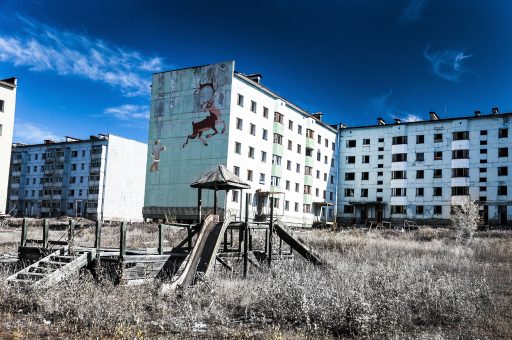
Secrecy shaped everyday life around Kapustin Yar. The town of Znamensk, established as a closed settlement for range personnel and their families, was long absent from public maps. Travel in and out of the area required permits, and the region was widely perceived as a forbidden zone. For those living nearby, rocket tests meant bright streaks in the sky, sonic booms and occasional fragments of wreckage falling in remote grazing lands.

UFO Lore and “Russia’s Area 51”
It is in this atmosphere of secrecy and spectacular nocturnal launches that the legends took root. From the late 1940s onward, residents around Kapustin Yar began reporting unexplained lights, mysterious aircraft and strange phenomena. In UFO literature, the range is often portrayed as the Soviet counterpart to America’s Area 51, allegedly hiding crashed alien spacecraft and bodies in underground bunkers.
One oft-retold story describes a supposed crash of a disc-shaped object in 1948, allegedly shot down near Kapustin Yar and taken to the base for examination, with an alien corpse recovered. Later tales speak of a second crash in 1961, rumours of zones where animals refuse to graze and claims that human pulse rates are affected when entering the area. None of these accounts is supported by verifiable documentary evidence, and they largely rest on anonymous testimonies, secondary reports and the fertile imagination of UFO researchers.
What is clear is that for decades the range produced plenty of genuine “unidentified flying objects” in the literal sense: high-altitude rockets, re-entry vehicles and experimental aircraft whose purpose and trajectory were unknown to civilians who witnessed them. In the Cold War climate, when both sides were desperate to understand each other’s technology and secrecy was paramount, such sightings were almost inevitable. Whether or not one gives any credence to stories of extraterrestrial visitors, the mythology around Kapustin Yar reveals how ordinary people tried to make sense of a landscape dominated by secret weapons and unexplained lights in the night sky.
Environmental and Human Costs
The early decades of missile testing at Kapustin Yar took place in an era when environmental and health considerations were secondary to strategic priorities. Rockets crashed, exploded or scattered debris across wide expanses of steppe. Toxic propellants seeped into soil and water. Downrange, in what is now western Kazakhstan, villagers complained for years about falling missile stages, unexploded ordnance and suspected contamination of grazing lands.
Modern investigations and journalistic reports have documented concerns from communities in Kazakhstan who associate clusters of illness and livestock problems with the impact zones of tests conducted from Kapustin Yar and other Russian ranges. While it can be difficult to disentangle the precise contribution of the range from other factors such as industrial pollution, there is little doubt that decades of rocketry left a heavy footprint on the region.
Within the closed town of Znamensk, the picture is more ambiguous. On the one hand, residents enjoyed relatively high living standards by Soviet provincial norms, with stable employment and state investment. On the other hand, they lived next to a landscape bristling with hazardous technology, where accidents could and did occur. Public information about specific incidents remains sparse, but the global record of rocket testing elsewhere suggests that Kapustin Yar was unlikely to be an exception to the pattern of occasional catastrophic failures.

Kapustin Yar after the Soviet Union
With the collapse of the USSR in 1991, many Soviet military facilities faced drastic budget cuts, closures or transfer to successor states. Kapustin Yar, however, remained firmly within Russian territory and retained its core mission as a missile test range. Through the 1990s and 2000s, it hosted tests of tactical and operational-tactical systems, including variants of the Iskander missile complex, as well as continued work on anti-aircraft and anti-ballistic systems.
In the 2010s, Russian officials announced significant modernisation of the range’s infrastructure, with upgrades planned to be completed around 2017, including new launch positions and updated measurement and telemetry equipment. The site has also been used for test launches of intercontinental ballistic missiles, with Moscow on at least one occasion formally notifying the United States under arms-control arrangements about an ICBM fired from Kapustin Yar.
Space-related activities have continued at a low level. The Kosmos-series launchers derived from medium-range missiles still occasionally loft small payloads from the range, although Kapustin Yar remains far less prominent than Russia’s main spaceports at Baikonur (leased from Kazakhstan) and Plesetsk.
A Target in a New War
The invasion of Ukraine in 2022 and the ensuing conflict have again drawn attention to Kapustin Yar. In July 2024, Ukrainian sources and Western media reported that a long-range drone strike had hit the area of the Kapustin Yar missile test site, approximately 400 miles from the front lines. Another report described multiple unmanned aerial vehicles striking facilities associated with the 4th Missile Test Range near Znamensk.
If these accounts are accurate, they suggest that the range is still regarded as a vital node in Russia’s strategic infrastructure – important enough for Ukraine to risk precious long-range drones on a deep-strike mission. They also highlight how a site born in the early Cold War remains entangled in the military confrontations of the twenty-first century, its runways and launch pads now potential targets as well as origins of weapon systems.
Secrecy, Access and Perception Today
Despite periodic glimpses via satellite imagery, leaked photographs or controlled media visits, Kapustin Yar remains a closed military enclave. There is no ordinary tourism; access is restricted to authorised personnel, and the town of Znamensk retains a semi-closed status. The most accessible views of the range come from orbit, through commercial satellite pictures that show an intricate pattern of launch pads, trenches, support buildings and instrument fields spread over more than a hundred kilometres.
For those intrigued by “unknown worlds”, Kapustin Yar occupies an ambiguous place. It is at once thoroughly real – a documented missile test site with a clear history – and persistently mythologised. Television documentaries, books and online forums repeat stories of alien artefacts, strange experiments and hidden hangars carved into the steppe. Much of this material is speculative or sensationalist, yet it reflects a genuine sense that something extraordinary, if purely human, has happened here for nearly eighty years.
Conclusion: A Mirror of the Rocket Age
Kapustin Yar’s story is, in many ways, the story of the rocket age itself. Born from the ashes of the Second World War, fuelled by captured technology and Cold War competition, it nurtured missiles that could carry both scientific instruments and nuclear warheads. It sent dogs to the edge of space, tested radars that scanned the skies for enemies and contributed to air-defence systems deployed across half the globe.
At the same time, its isolation, secrecy and the often frightening spectacle of night-time launches gave rise to rumours and legends that continue to colour its reputation. The UFO stories may never be more than folklore, but they reveal how ordinary people respond when state power and advanced technology converge in distant, restricted landscapes.
Today, as drones and satellite cameras probe the once-hidden corners of the earth, Kapustin Yar is no longer quite as invisible as it once was. Yet much about its current operations remains classified, and the full history of what has been tested, launched and perhaps lost on its range may not be known for decades. Until then, this remote stretch of Russian steppe will remain an enigmatic landmark – a place where science, war, secrecy and myth collide on the thin edge between earth and sky.