Hidden in the rolling hills of eastern Pennsylvania lies Centralia, a near-empty borough whose name has become synonymous with an underground mine fire that has burned for decades. What was once an ordinary anthracite coal town is now a byword for environmental catastrophe, policy missteps and the tenacious afterlife of fossil-fuel landscapes. Centralia’s story is not merely a curiosity for disaster enthusiasts; it is a window onto the industrial past of the United States, the chemistry and physics of coal fires, the complexities of resettlement, and the stubborn ways in which places endure in memory long after they have faded on the map. This article offers a detailed account of how Centralia came to be, how it unravelled, and why it still matters.
A Town Built on Anthracite
Centralia was established in the mid-nineteenth century above one of the richest anthracite seams in North America. Anthracite, the hardest and most carbon-dense form of coal, combusts cleanly compared with other ranks and burns at higher temperatures, making it prized for heating and industry throughout the nineteenth and early twentieth centuries. Railways snaked across the region to funnel black fuel to cities and factories, and towns like Centralia grew around collieries, breakers and company stores. Immigrant labour from Ireland, Wales, Eastern Europe and elsewhere provided the muscle for an industry that was dangerous and, during boom years, lucrative.
The rhythms of daily life were organised around the mines. Men descended each morning into a labyrinth of gangways and chambers, while above ground the breakers reduced coal, sorting it by size for different markets. Churches, bars, fraternal halls and schoolhouses stitched together a tight community. It was not a wealthy place, nor a soft one, but it was defiantly its own. For generations, families expected their sons to follow their fathers underground, even as the industry’s margins thinned and competition from oil, gas and bituminous coal began eroding anthracite’s dominance.

Decline Before Disaster
By the mid-twentieth century Centralia, like many towns in Pennsylvania’s coal country, was already facing economic headwinds. Mechanisation reduced the number of jobs. Safer and cheaper fuels competed for household heating. When the Second World War ended, the high wartime demand for coal ebbed. Mines closed or shifted to smaller-scale operations, including contour and strip mining that exposed older underground workings to the surface. The web of tunnels beneath Centralia—some active, many abandoned—made the geology complex and, in hindsight, precarious.
It is important to understand this pre-existing backdrop of decline because it complicates any simple narrative that the town was thriving until the fire. Centralia was already vulnerable when misjudgements and bad luck combined to create one of the most persistent mine fires in modern history.
The 1962 Fire: Origins and Ignition
The conventional timeline points to late May 1962, when the borough council sought to tidy up the local tip near an old open pit, which cut into abandoned mine workings. Rubbish disposal by burning—far from unusual at the time—was undertaken without the robust isolation measures necessary to prevent ignition of exposed coal seams. There is debate in the historical record about details: whether the borough’s fire crew ignited the rubbish intentionally as part of clean-up, whether other fires had smouldered there previously, or whether barriers meant to confine the burn were incomplete. What is reasonably clear is that heat migrated into fractured, oxygenated coal, setting off a subterranean combustion.
Once anthracite ignites underground with access to air, it is exceedingly difficult to extinguish. Coal seams provide fuel; fissures, old shafts and surface cracks admit oxygen; and overburden insulates the heat. The fire can propagate along bedding planes for kilometres, burning quietly until it finds vents where hot gases escape to the surface. In Centralia, that process unfolded beneath homes, streets and public spaces, a nightmare in slow motion.

Early Responses and Missed Chances
During the first years, local and state authorities attempted a sequence of interventions. Firefighters flooded areas with water, which in theory cools and removes heat. Engineers drilled boreholes to sample temperatures and gases, and they attempted to isolate burning zones with trenches or inert fill. Some efforts suffered from inadequate funding; others were simply misdirected because the fire’s true extent underground was not well mapped. Subsurface fires are notoriously hard to visualise. Thermal surveys in the 1960s indicated pockets of intense heat, but the town sat above a tangled mesh of old workings that allowed the fire to bypass barriers.
By the early 1970s, signs of danger multiplied. Pavements buckled as subsidence created voids; wisps of smoke and steam rose from cracks after rain; and carbon monoxide—a colourless, odourless gas—seeped into basements. The incident that seared itself into public memory occurred on Valentine’s Day 1981, when a young boy, Todd Domboski, fell into a sudden sinkhole that opened in his grandmother’s garden. He was rescued, but the near-tragedy confirmed what many already feared: the ground beneath Centralia was becoming treacherous.
Relocation and a Town Emptied
After years of debate, the United States Congress approved funds in the 1980s for voluntary relocation. Families were offered buyouts; homes were acquired and, in most cases, demolished. Relocation is always about more than property; it is about disentangling people from place. Centralia’s removal programme strained friendships and split households as some residents left promptly while others clung to their homes, whether out of scepticism of the danger, attachment to the town, or distrust of the authorities. In 1992, the Commonwealth of Pennsylvania invoked eminent domain over remaining properties, effectively condemning the borough. A small number of holdouts fought a long legal battle, eventually receiving lifetime occupancy rights but relinquishing their titles. As the years passed, streets that once held rows of houses became grassy corridors lined by lone kerbstones and the occasional stubborn mailbox.
By the 2000s, only a handful of residents remained. The borough government diminished to a formal shell. The post office closed, its ZIP code retired. At the same time, Centralia’s emptiness began drawing visitors in search of the eerie and the photogenic, a development that brought its own complications.

The Science of a Coal Seam Fire
Coal seam fires are not unique to Centralia, but the town’s case is one of the most studied and long-lived in the United States. Combustion underground follows the same thermodynamics as any fire: fuel, oxygen and heat form the triangle. In anthracite terrain riddled with historic workings, the geometry of that triangle is unusually favourable. Temperature readings from boreholes have registered hundreds of degrees Celsius in burning zones. As coal oxidises, it releases gases—carbon monoxide, carbon dioxide, sulphur compounds—along with water vapour. These gases travel through fractures, emerging at vents where they can be measured.
Attempts to extinguish such fires fall into three broad strategies: starving the fire of oxygen by sealing pathways; cooling it by flooding or grouting; or isolating and excavating burning material. Each strategy is expensive and uncertain across a large area with complex geology. In Centralia’s early years, officials oscillated among these approaches. If an all-out, well-funded effort had been attempted in the 1960s, might the fire have been contained? Some engineers argue yes, but hindsight is imperfect, and budgets were tight. What is not in doubt is that, once the fire had migrated beyond the immediate ignition zone, the cost of a definitive intervention ballooned beyond what was politically feasible.

The Landscape Today
Walk through Centralia now and you encounter absence as much as presence. The town grid is still faintly visible, with street signs that seem to point to nowhere. Patches of low vegetation cover lots where homes used to be. In cooler weather, wisps of steam still rise from vents where the hot ground meets the air, though many visible emissions have diminished compared with the most active decades. The danger is less theatrical than it is insidious: ground that looks solid may conceal voids; gases that cannot be seen may displace oxygen.
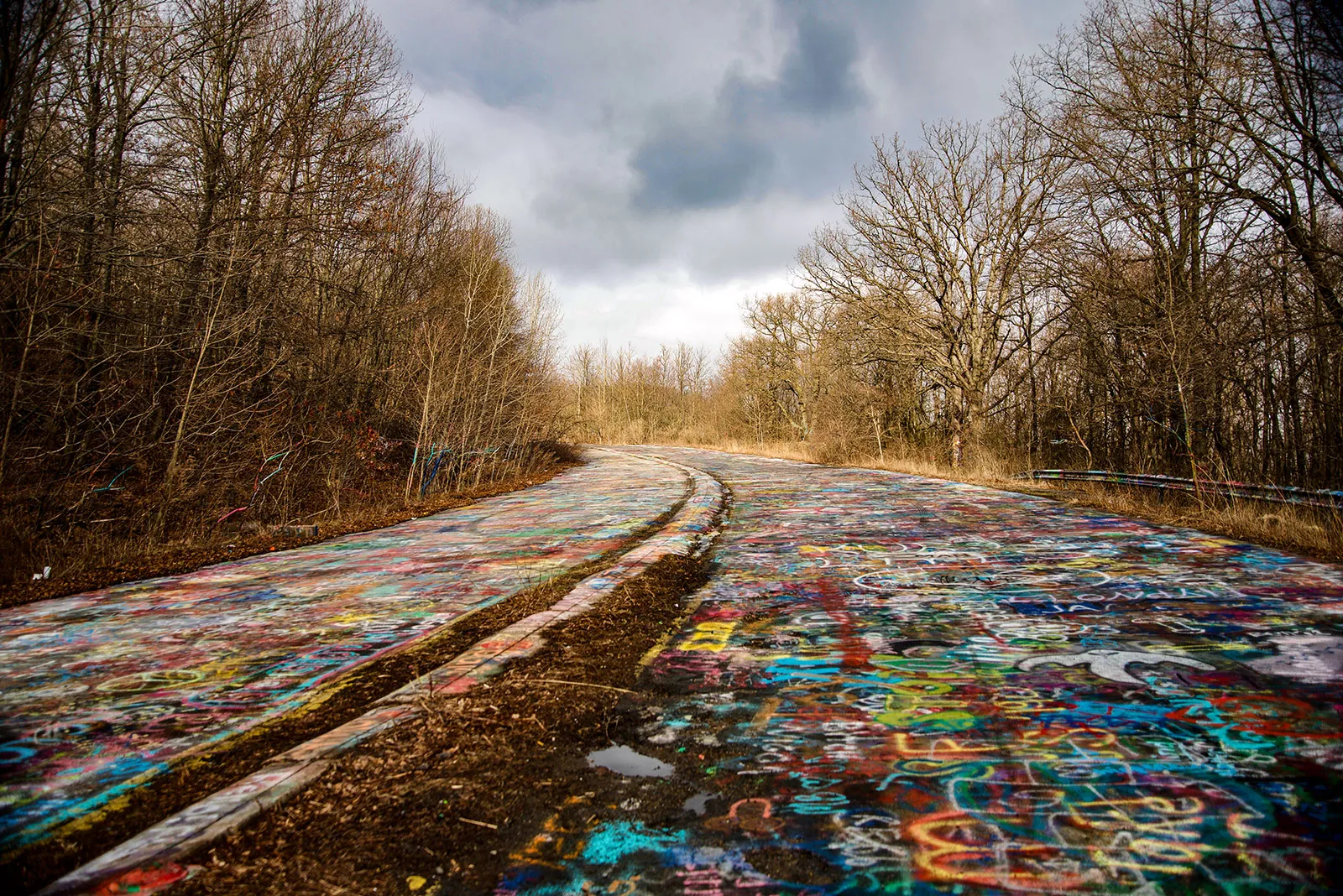
For years, the most visible symbol of Centralia’s afterlife was a section of the old Route 61, diverted when subsidence made the original road unsafe. The abandoned tarmac, warmed from below and cracked by heat, became a canvas for graffiti artists and social-media pilgrims. Authorities eventually moved to discourage trespass, and earthworks were carried out to obscure access. Even so, the idea of Centralia as an open-air ruin proved hard to extinguish. The town’s only active congregation, St Mary’s Ukrainian Catholic Church on the hill, continued to hold services, a poignant reminder that places are not defined solely by their defects.
Health, Safety and the Long Tail of Risk
One of the enduring debates about Centralia concerns the health risks of chronic exposure to mine-fire emissions. Carbon monoxide binds to haemoglobin more readily than oxygen, preventing blood from carrying sufficient oxygen to tissues; at high doses it kills, at lower doses it can cause headaches, dizziness and cognitive effects. Hydrogen sulphide and other gases, though typically at lower concentrations, can also be harmful. During the peak years, homes were fitted with monitors and some residents reported health complaints. At the same time, risk perception varies: what one family regards as intolerable, another may see as manageable with ventilation and caution. The sinkhole hazard is less negotiable; subsidence can occur without warning where voids and caving progress.
The environmental reach of the fire extends beyond human health. Vegetation patterns shift where soils warm or dry; winter snow melts faster above hot zones; and small mammals alter their burrowing behaviour. While the scar is local, it is a vivid reminder that energy systems imprint ecologies long after the mine gates close.

Law, Policy and the Problem of “When to Leave”
Centralia sits at the intersection of geology and governance. The legal saga—from eminent domain to the life-estate compromise for holdouts—offers a case study in how authorities balance individual rights with collective safety. Government agencies face grim arithmetic: spend large sums with no guarantee of extinguishing the fire, or fund relocation that fractures a community but reduces risk. The decision to relocate was, in effect, an admission that the fire would outlast several generations. That may feel like defeat, yet it is also pragmatic policy in the face of an implacable physical process.
The episode also exposes the limits of reactive governance. If the initial rubbish-tip burn had been better managed—by isolating the site from exposed coal, for example—Centralia might never have become a byword for subterranean catastrophe. That lesson resonates today as communities grapple with legacy mines, waste dumps and industrial brownfields. Preventive measures are rarely glamorous, but they are cheaper than perpetual remediation.
Culture, Myth and the Afterlife of a Place
Beyond geoscience and policy, Centralia lives on in culture. Its smoke-wreathed emptiness inspired video games, novels and films; perhaps most famously, it influenced the moody, depopulated aesthetic of the “Silent Hill” franchise. Photographers documented prised-open pavements and the skeletal remains of porches. Travel writers wove gothic narratives around a smouldering town emptied of its people. Such portrayals range from thoughtful to exploitative. For some former residents, the fascination stings; for others, it is a way to keep the town’s story alive. Either way, Centralia has migrated from map to myth, a cautionary fable about extractive industries and unintended consequences.

Lessons for an Energy Transition
As the world confronts climate change and navigates an energy transition, Centralia’s long burn offers several lessons. First, fossil-fuel landscapes are durable. Even after production stops, seams can ignite; spoil tips can slip; groundwater can acidify. The ‘end’ of a mine is a misnomer. Stewardship obligations run for decades, often beyond the lifespan of the companies that profited from extraction. Second, monitoring matters. Thermal imaging, gas sampling and careful mapping can guide interventions, allocate limited resources wisely and protect inhabitants when prevention fails. Third, relocation policies must be humane. People do not only own houses; they are rooted in streets, churches, sports teams and cemeteries. Compensation alone cannot capture those values, but transparent processes, community participation and attention to social ties can minimise harm.
Finally, Centralia cautions against complacency in waste management. The ignition in 1962 was not a trick of fate but the foreseeable risk of burning rubbish adjacent to exposed coal. In countless communities today, decisions that look minor—where to dump spoil, how to cap a landfill, when to replace a corroded pipeline—carry long shadows.
The Future: Smouldering into the Next Century
How long will Centralia burn? Estimates have varied widely, depending on assumptions about the seam geometry and oxygen supply. In the absence of a full extinguishment campaign, the fire will continue to migrate through accessible coal until it runs out of air or fuel. That may mean many more decades. As it travels, its surface expressions may shift, quieting in one area while flaring in another. The remaining residents with life rights will pass on, the borough’s legal framework will shrink further into formality, and the landscape will keep rewilding. Lilacs and sumac will colonise old lots; deer will thread through the empty grid; frost will lift and settle cracked kerbs that lead nowhere.
Yet Centralia will not vanish entirely. It exists in court archives and academic papers, in family albums and parish ledgers, in the cautionary slide decks of engineers and the imaginations of artists. It exists, too, in the practical knowledge of emergency managers who examine the town’s history to design better responses elsewhere. The coal that once built Centralia’s homes is still burning beneath them, but its legacy is no longer only heat and gas. It is a set of questions about how societies inherit the consequences of their energy choices, and what fairness looks like when the bill arrives generations later.

Conclusion
Centralia, Pennsylvania, is more than a curiosity on a road-trip itinerary. It is the material residue of a century of extractive ambition, a case study in how small errors can trigger vast, long-lived consequences, and a meditation on belonging in places where the ground itself has become an adversary. To stand on a quiet Centralia street and feel warmth rise through your boots on a winter’s day is to grasp, viscerally, how the past can smoulder underfoot. For all the science that describes the burn and the painstaking policy that managed its aftermath, the town’s poignancy lies in its ordinariness: a community that lived, worked and played until one day it was asked to leave, while the fire, impersonal and patient, carried on.


