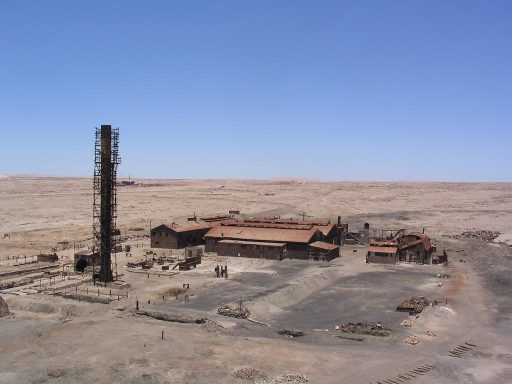
In the middle of the Atacama Desert, far from the Pacific coast and modern mining towns, the ruins of Oficina Salitrera Chacabuco lie behind a perimeter wall and a 35-metre chimney that still dominates the horizon. Once a model nitrate settlement and later one of the most notorious political prison camps of the Pinochet dictatorship, Chacabuco today is a haunting composite of industrial archaeology and recent traumatic history.
Chacabuco forms part of the vast belt of former nitrate, or saltpetre, towns that spread across northern Chile in the late nineteenth and early twentieth centuries. These company settlements processed caliche ore into nitrate fertiliser and explosives for export to Europe, North America and beyond, underpinning the Chilean economy for decades. Yet Chacabuco stands apart. Its life as an industrial town was unusually short; its second life, as a concentration camp after the 1973 coup, left scars that are still being worked through today.
Birth of a nitrate town
The origins of Chacabuco go back to the early 1920s, when Anglo Nitrate Company Limited began building a new processing plant on the ruins of the older Oficina Lastenia, some 98 kilometres north-east of Antofagasta. Construction started in 1922 and the plant was formally inaugurated in 1924, occupying around 36 hectares of desert.
Chacabuco was designed as a modern, large-scale nitrate works using the Shanks system, an evaporation and crystallisation process that dominated the “golden age” of natural nitrate. The caliche was crushed, dissolved in very hot water and then crystallised out to produce refined nitrate. At its peak, the works could produce up to 15,000 tonnes of nitrate a year, shipped by rail to ports on the Pacific coast and from there to farms and munitions factories around the world.
In many ways Chacabuco was the last great Shanks-system complex in the Atacama. By the time it opened, global chemistry was already shifting the balance against Chilean nitrate. Synthetic nitrate, developed in Germany in the early twentieth century, was becoming commercially viable, threatening the natural deposits that had fuelled Chile’s export boom.

A planned city in the desert
Like other oficinas salitreras, Chacabuco was not just a factory but an entire company town, laid out as a self-contained urban island in the desert. Its plan followed a grid pattern, with broad streets running at right angles and a central square acting as the social and symbolic heart.
On one side of the settlement lay the industrial sector: the massive boiler house, engine rooms, machine shops, warehouses, loading areas and the long battery of steel tanks where the nitrate solution was processed. Here iron and steel predominated, along with imported Oregon pine for roof trusses and walkways. The chimney towered above this zone, visible for kilometres in every direction, like a vertical exclamation mark against the blue Atacama sky.
On the other side of the town wall were the living quarters and social infrastructure, built largely in adobe. Rows of terraced workers’ houses, with small courtyards and shade structures, lined the streets in uninterrupted blocks. Chacabuco could house around 5,000 people – workers and their families – and its owners prided themselves on offering relatively complete amenities.
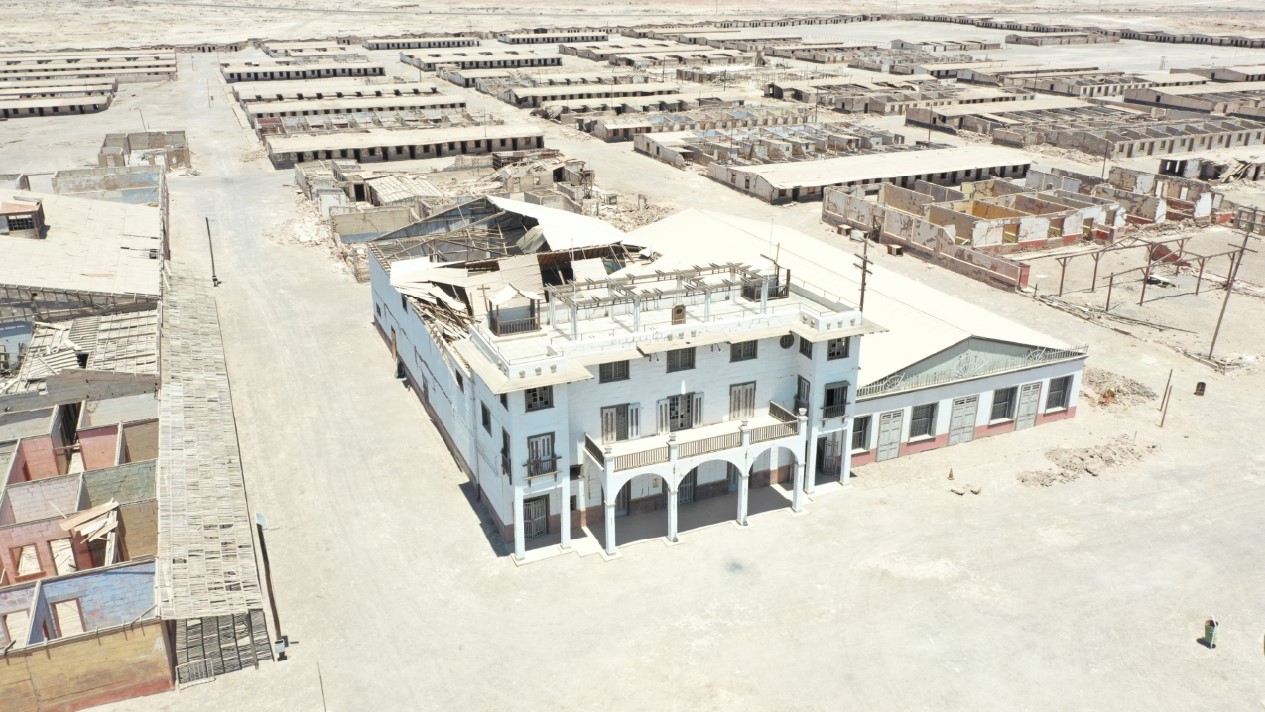
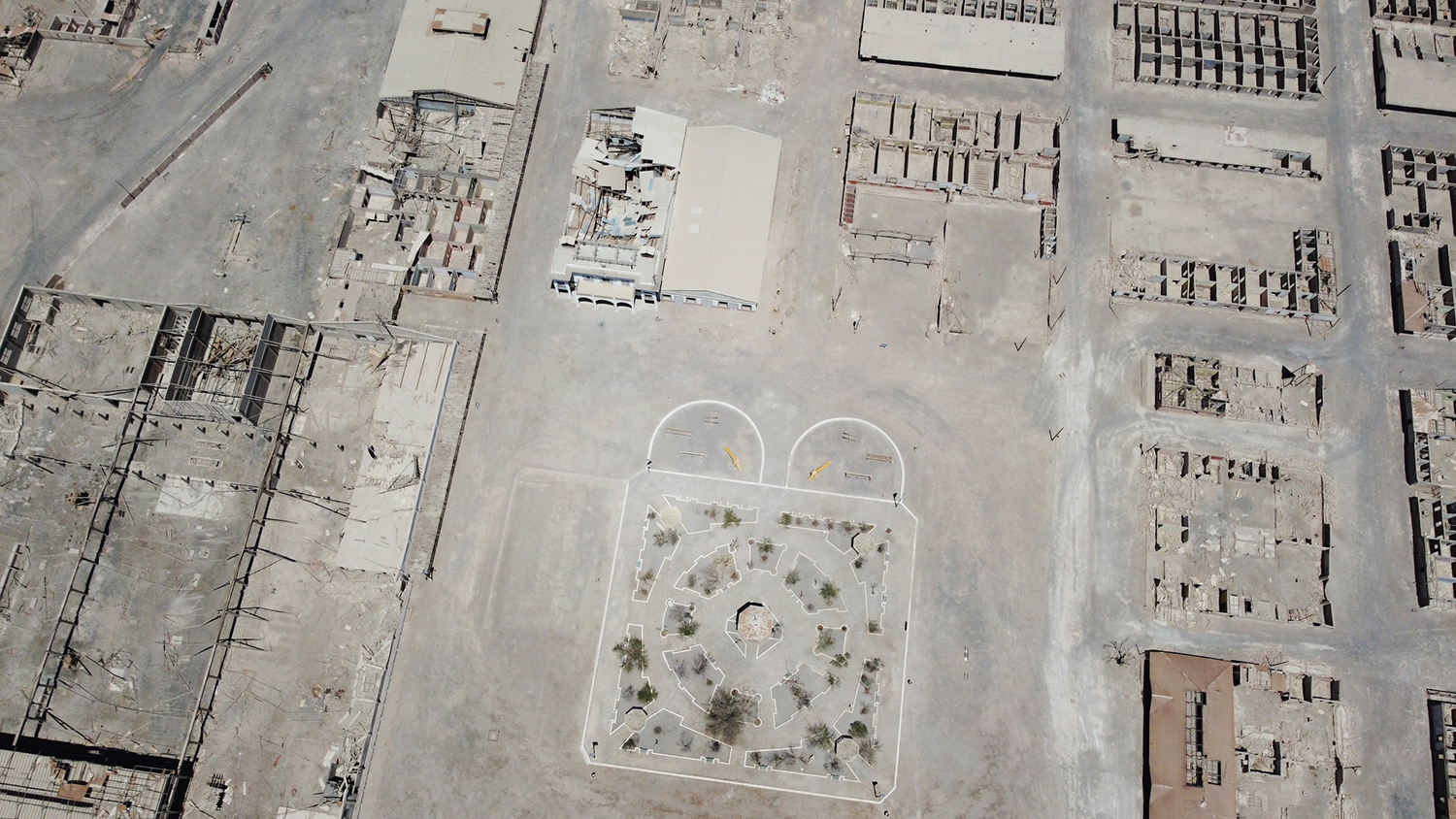
For such an isolated settlement, the list of facilities was striking. There was a hospital, a school, a hotel and guest house, a pulpería company store, a market, a gymnasium, a swimming pool, football pitches and a tree-planted plaza with a cast-iron bandstand. Above all rose the three-storey theatre, a whitewashed building with a colonnaded façade, which contained not only an auditorium but also a library and meeting rooms.
Wages and social benefits were structured to encourage family life; workers with families were paid more than single men, an attempt to create a more stable, “respectable” community in what might otherwise have been a transient mining camp. The culture that developed in these desert towns, known as pampino culture, had its own expressions of solidarity, creativity and labour organisation that would later have a deep impact on Chilean social history.
Bust after boom
Chacabuco’s optimism was short-lived. The world economy was already shifting when the Great Depression hit in 1929. Synthetic nitrates reduced global demand for Chilean saltpetre, and the collapse of export markets dealt a further blow.
According to Chile’s Consejo de Monumentos Nacionales, technological obsolescence combined with the Great Depression to make Chacabuco unprofitable; production was progressively scaled back and operations were definitively halted in 1940. Wikipedia dates the effective closure of the town to 1938, emphasising that as a community it survived barely fourteen years.
Once the machinery went silent, the dismantling began. From 1945, valuable materials such as rails, machinery and timber were removed and sold off, a process that has scarred many nitrate towns across the Atacama. But Chacabuco, encircled by its perimeter wall and relatively remote, remained more intact than many others. The desert climate, harsh yet dry, preserved adobe walls and rusty boilers alike in a kind of suspended decay.
In 1968 the site was sold to the chemical and mining company SOQUIMICH. Yet the industrial rebirth some may have imagined never came. Instead, an entirely different chapter of history was about to be written in its empty streets.

From industrial monument to concentration camp
By the early 1970s, the Chilean state had recognised the heritage value of the nitrate era. In 1971, President Salvador Allende declared the Oficina Salitrera de Chacabuco a National Monument, and limited restoration work began on some key buildings, notably the theatre.
That gesture of preservation was brutally repurposed after 11 September 1973, when General Augusto Pinochet led a military coup that overthrew Allende. The new regime saw in Chacabuco an ideal detention site: remote, enclosed by walls and far from urban centres. The armed forces expropriated the property and converted part of the former town into a prison and torture camp for male political prisoners from cities such as Copiapó, Valparaíso, Santiago, Linares and Concepción.
Between 1973 and the end of 1974, Chacabuco held up to 1,800 inmates, many of them professionals, artists, teachers and trade unionists associated with the overthrown government. The south-eastern quarter of the town was enclosed by electrified fences and guarded by watchtowers; landmines were laid around the perimeter to prevent escape.
Inside, prisoners slept in the former workers’ rows of adobe housing, ate in makeshift mess halls and were subjected to interrogations and torture in rooms that had once served as offices, workshops and storage spaces. Testimonials describe harsh conditions but also efforts to resist dehumanisation: classes in philosophy, poetry readings, musical performances and even improvised astronomy lessons, memorably evoked by a former prisoner in the film “Nostalgia for the Light”.
Executions and disappearances formed part of this regime of terror. The same desert isolation that had once symbolised the heroic conquest of nature by industry now served a different purpose: to hide abuses from public scrutiny. In later decades Chile would reckon with the dictatorship’s human rights violations, estimated at more than 3,000 dead or disappeared and tens of thousands detained and tortured, with Chacabuco cited as one of its most infamous camps.
The camp closed around 1975, and Chacabuco fell silent again. The landmines, however, remained, and to this day several dozen unexploded devices are believed to lie in the surrounding desert, a stark reminder that the landscape itself is still partially weaponised.
Preservation, deterioration and a lone caretaker
After Chile’s return to democracy in 1990, Chacabuco became state property, administered by the Ministry of National Assets. Its status as a National Monument was reaffirmed and extended in 1989 to include the vast “tortas” – the spoil heaps of waste mineral that ring the industrial zone – and in 2018 it was officially designated a human-rights memory site.
Yet official recognition did not prevent decay. Looting and the removal of valuable Oregon pine beams left many buildings structurally fragile, and the church was destroyed by fire in the late 1980s.
A crucial role in preserving what remains was played by former prisoner Roberto Saldívar. In 1991 he returned to Chacabuco and chose to live almost entirely alone there, acting as a self-appointed guardian against vandalism and a living link to the camp’s history. He remained in residence until January 2006, when he left due to ill health and later died. His work was taken up by another caretaker, Pedro Barreda, who continues to live on site, guiding visitors and maintaining a minimal presence in the ghost town.
International and Chilean organisations have undertaken selective restoration projects. The theatre has been stabilised and partially restored; inside, an exhibition presents the history of nitrate mining and Chacabuco’s transformation into a detention camp, with bilingual panels and display cases of artefacts from workers and prisoners. Informational boards scattered through the streets encourage visitors to walk a circuit through industrial ruins, workers’ housing, administrative blocks and the area that once housed the camp’s electrified perimeter.
Despite these interventions, much of Chacabuco remains in a state of advanced deterioration. Walls bow and crack, roofs have fallen in and rusting machinery slumps amid piles of rubble. The desert climate preserves but also slowly erodes; salt, wind and intense sunlight conspire to wear down both adobe and steel.
Chacabuco today: tourism and silence
Today Chacabuco sits just off the junction of Chile’s Route 5 (the Panamericana) and Route 25 to Calama. A short access road leads to the gate in the northern wall, where visitors pay a modest entrance fee and step into a space that is at once museum, ruin and cemetery of memories.
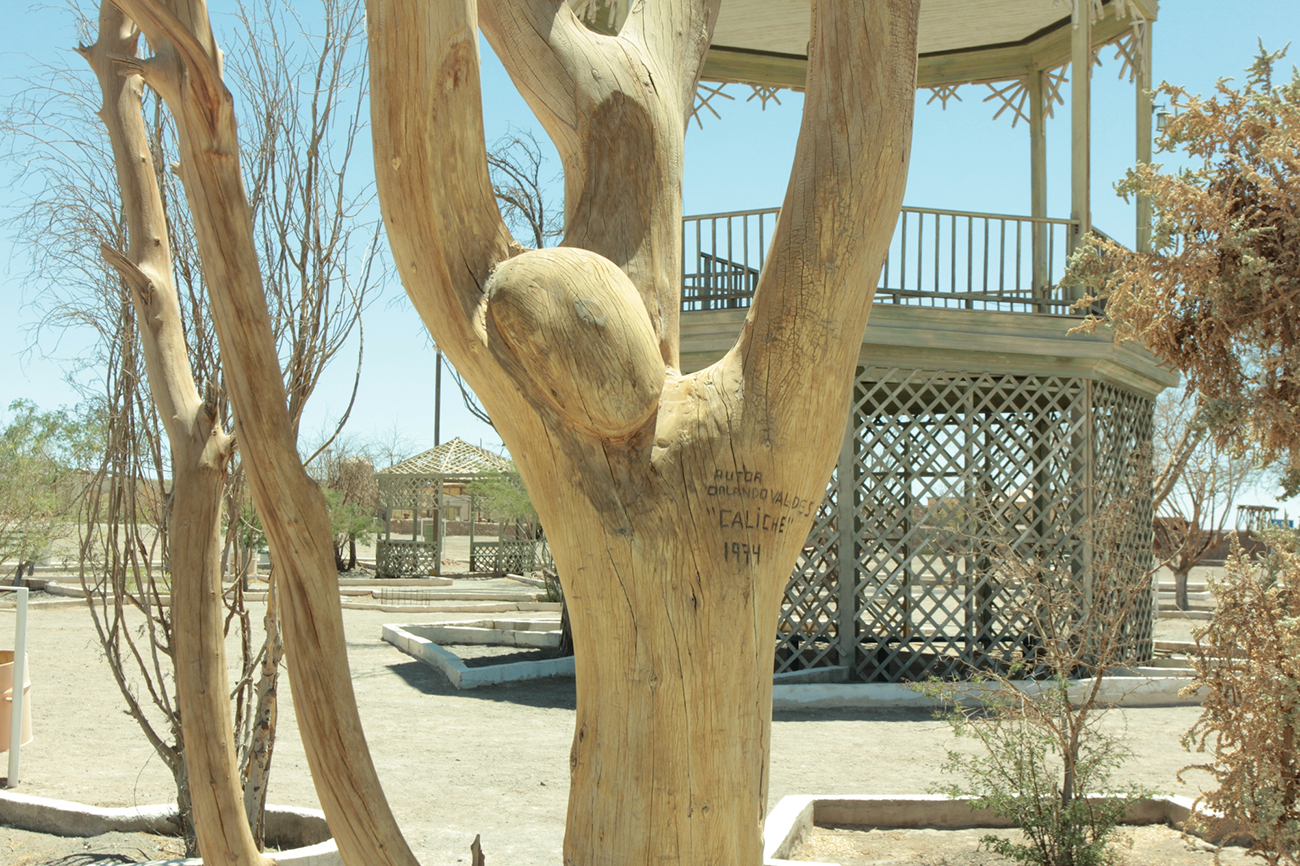
Walking across the central square, with its refurbished bandstand, benches and incongruously cheerful loudspeakers, visitors confront a disconcerting layering of times. The grand theatre evokes the nitrate era’s aspiration to civilised modernity in the desert; the adjacent exhibition rooms confront them with images and testimonies from the dictatorship. The long rows of roofless housing blocks to the south-east recall both the daily routine of pampino families and the cramped confinement of political prisoners.
Towards the industrial zone, the skeletal remains of the Shanks processing plant and its huge boilers dominate the landscape, standing against a horizon of pale spoil heaps that form strange “cakes” of waste material. Beyond them, the cemetery lies outside the walls, where wrought-iron flowers and rusted railings decorate graves slowly being swallowed by sand.
Chacabuco is now included in regional heritage routes that link former nitrate towns and mining sites, alongside the better-known UNESCO-listed works of Humberstone and Santa Laura and the still-inhabited oficinas of Pedro de Valdivia and María Elena. Yet its character remains darker and more introspective than most industrial heritage attractions. The memory of detention and torture sits uneasily beside the picturesque appeal of rust and ruins that attracts photographers and “ghost-town” enthusiasts.
Visitors are warned not to wander off marked tracks or drive off-road because of the lingering danger posed by landmines scattered in the surrounding desert. Thus even today, the landscape around Chacabuco is literally mined with the remnants of state violence.

Layers of memory in the Atacama
Oficina Salitrera Chacabuco condenses within its walls some of the most intense themes of Chilean history: the boom and bust of export-led resource extraction, the creation of company towns and distinctive working-class cultures, the violence of technological and economic obsolescence, and the trauma of dictatorship and political repression.
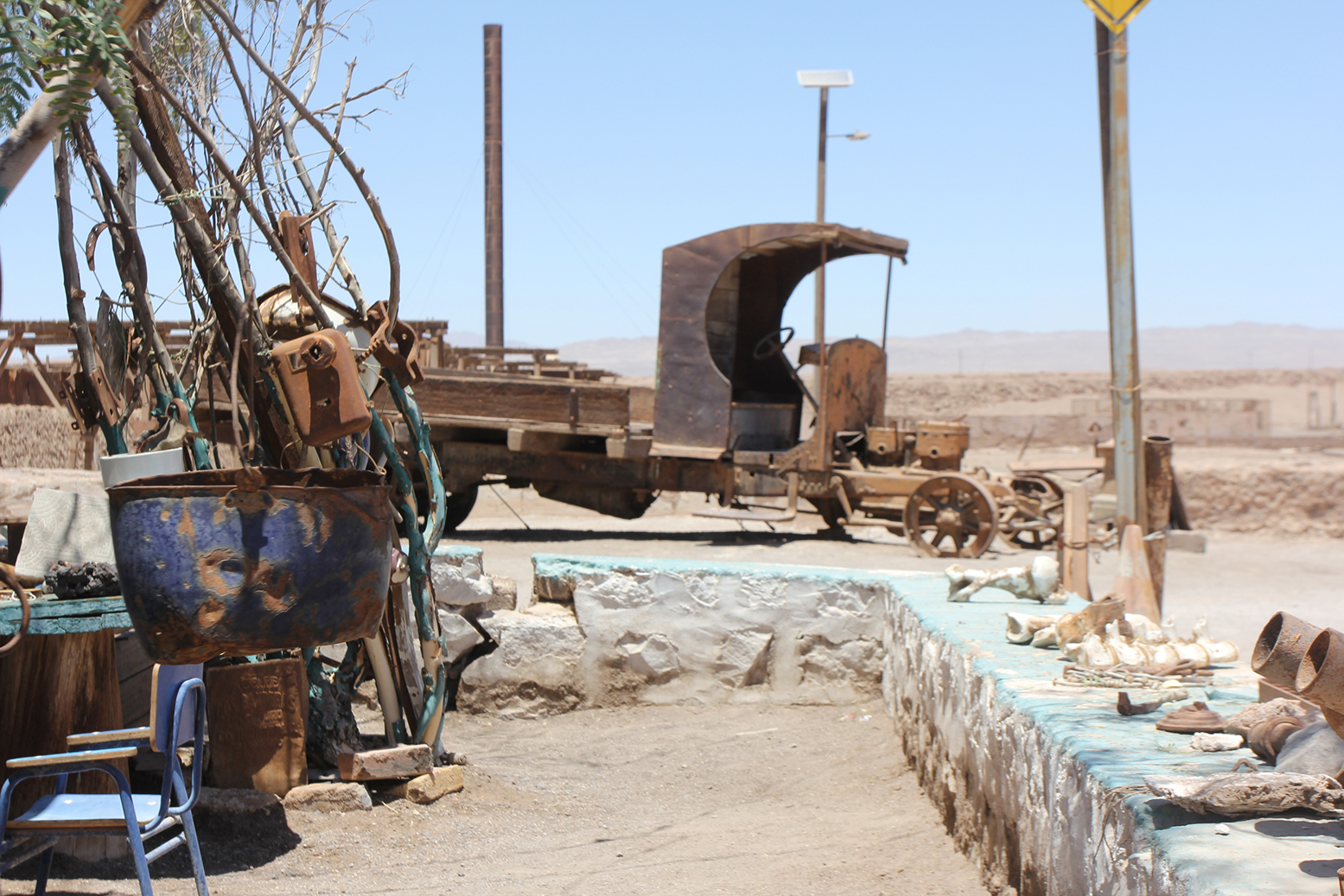
As a ruin in the Atacama, it also speaks to broader questions about how societies remember and forget. The desert is often imagined as empty and timeless, a backdrop for astronomy and geology rather than human stories. Yet in Chacabuco the desert is full of traces: industrial debris, political graffiti, the foundations of a burned-out church, the rusted remains of vehicles, the invisible but very real presence of landmines.
In recent years Chile has increasingly embraced sites like Chacabuco as places of both industrial heritage and human-rights memory, acknowledging that the same walls which once promised progress later enclosed suffering. The delicate task now is to maintain and interpret these ruins in a way that respects both histories: the pampino workers who laboured here in the nitrate boom, and the prisoners who later turned the same dust and stars into tools of intellectual and spiritual resistance.
Standing in the empty streets of Chacabuco, with the wind whistling through broken windows and the chimney casting its long shadow, it is easy to feel that the town is frozen in time. In reality, its meaning is still evolving, shaped by former prisoners, caretakers, historians, tourists and the relentless forces of the Atacama itself. As long as its walls stand, however precariously, Chacabuco will continue to bear witness – to the rise and fall of an industry, to a period of terror, and to the stubborn persistence of memory in the world’s driest desert.