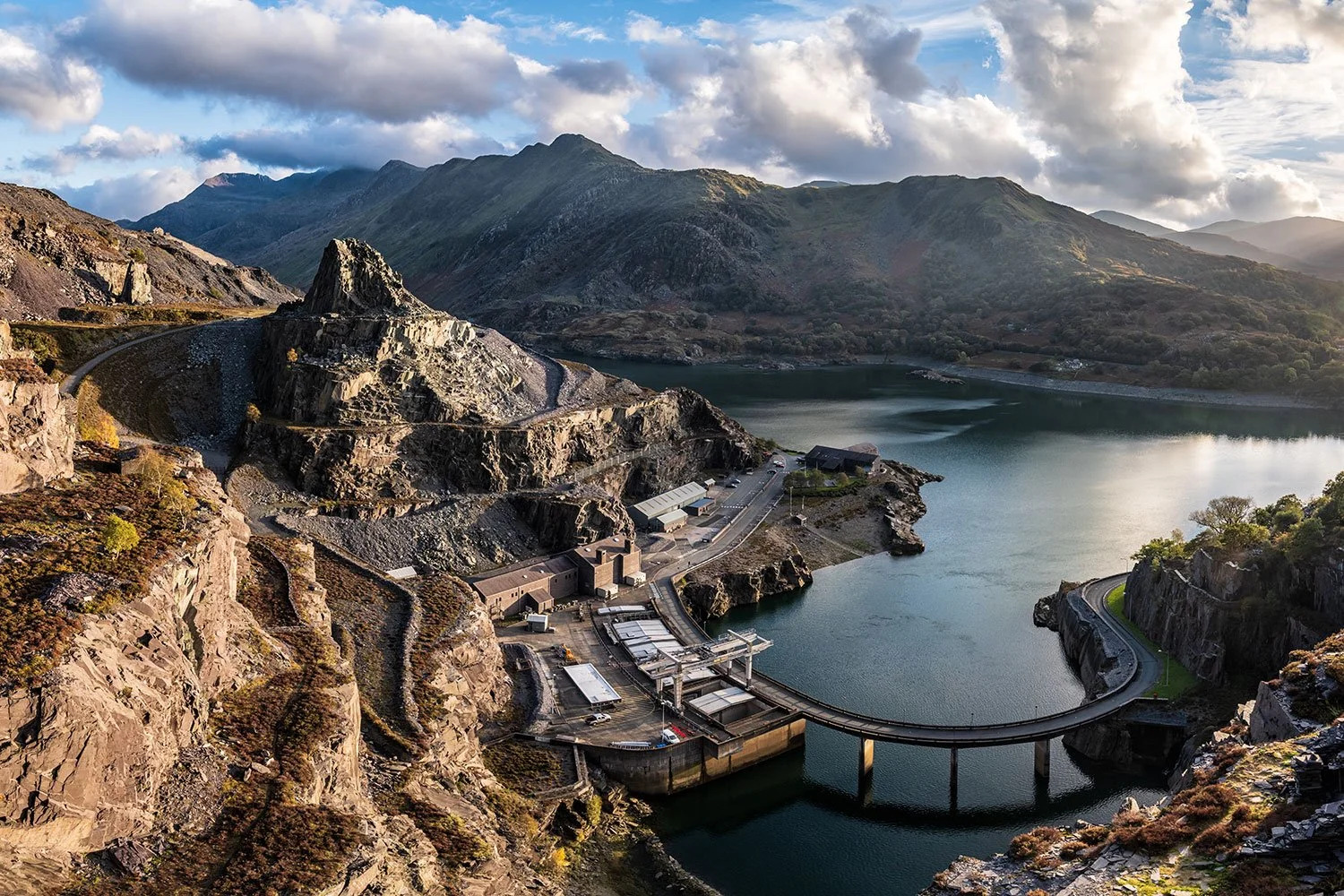
Between the twin lakes of Llyn Padarn and Llyn Peris, beneath the flanks of Elidir Fawr and within sight of Yr Wyddfa (Snowdon), lies one of the most dramatic post-industrial landscapes in Britain. Dinorwic slate quarry in north-west Wales was once a powerhouse of the global roofing trade and the beating heart of a Welsh-speaking industrial community. Today it is a monumental ruin of terraces, tips and tramways, part open-air museum and part ghost town, folded into the rugged scenery of Eryri (Snowdonia) and recognised by UNESCO as part of the Slate Landscape of Northwest Wales.

Origins on the Slate Vein
The story of Dinorwic begins in the late eighteenth century, when slate was becoming an increasingly desirable roofing material for Britain’s rapidly expanding towns and cities. The slate vein that runs through this part of north-west Wales is almost vertical and lies close to the surface, making it comparatively easy to reach by quarrying rather than deep mining.
In 1787 a private partnership obtained a lease from the local landowner, Thomas Assheton Smith of the Vaynol Estate, to work slate on the mountainside above the village of Llanberis. Early efforts were modest. War with France, high transport costs and taxes constrained growth. The location, however, was promising: the mountain offered abundant high-quality slate, and the Menai Strait lay within carting distance, providing access to wider markets.
When the original lease expired in 1809, Assheton Smith formed a new company and took more direct control. This proved decisive. Investment in infrastructure, particularly in transport, allowed the quarry to flourish. In 1824 a horse-drawn tramway, the Dinorwic Railway, was constructed to carry slate from the quarry down to new dock facilities at Port Dinorwic (Y Felinheli) on the Menai Strait, replacing earlier, more cumbersome methods of moving slates by cart and lighter.

Growing into a Slate Giant
Through the nineteenth century Dinorwic expanded spectacularly. By the 1870s the quarry employed over 3,000 men, a workforce on the scale of a small town. By this time slate had become one of Wales’s most important industries, and Dinorwic was a flagship enterprise within it. Wales produced over four-fifths of all roofing slate used in Britain, and Caernarfonshire – the county that included Llanberis – was the leading producer.
At its height, Dinorwic was the second largest slate quarry in Wales and therefore one of the largest in the world, eclipsed only by the nearby Penrhyn quarry. It covered roughly 700 acres and was arranged as a series of vast stepped galleries on the mountainside, each with its own waste tips and linked by a complex network of internal tramways and inclines. The quarry eventually boasted over twenty galleries in each of its two main working sections, Vivian and Dinorwig proper, with additional pits like Wellington, Hafod Owen and the later Marchlyn quarry further upslope.
Annual production in the late nineteenth and early twentieth centuries reached around 100,000 tonnes of finished slate products. The quarry’s output roofed houses and public buildings not only throughout Britain but across the world, as slates shipped from Port Dinorwic found their way to ports in Europe, the Americas and beyond.


Life and Labour in a Welsh Quarry
The industrial landscape of Dinorwic was also a social one. The quarrymen and their families formed tight-knit, predominantly Welsh-speaking communities scattered around Llanberis, Dinorwig village and smaller settlements in the surrounding hills. Work at the quarry was hard, often dangerous, and deeply hierarchical.
Men were typically organised into small teams who leased a “bargain” – a section of rock from which they were expected to extract slate over a set period. Each group’s earnings depended on the quality of slate produced, and on market conditions beyond their control. Skilled splitters and dressers, working in the mills, transformed raw blocks into thin, even roofing slates using hand tools or machinery. Others laboured on the tips, in the engine houses or on the tramways and inclines that moved material up and down the mountainside.
The quarry also shaped local culture and politics. Chapel life, the Welsh language and the trade union movement all found fertile ground among slate workers, who were known for their strong sense of community and for periods of labour unrest, particularly in neighbouring quarries such as Penrhyn. Dinorwic had its own disputes over pay and conditions, though it escaped the prolonged and bitter strikes that crippled some competitors.

A Landscape of Engineering
Physically, Dinorwic is as much a monument to Victorian engineering as it is to geology. The nearly vertical slate vein was worked in stages, forming terraces stepping down towards the lakes. Each gallery had its own working faces, waste tips and small tramways, all connected by gravity-worked or powered inclines that hauled slate blocks, wagons and, occasionally, men between levels.
Steam power arrived early. By the mid-nineteenth century steam engines drove sawing tables and other machinery in the slate mills, replacing or supplementing water power. One later mill, known as Mill No. 3 and opened in 1927 on the site of an earlier 1840s mill, was designed specifically for sawing, splitting and dressing roofing slates using modern equipment.
The quarry also developed an internal narrow-gauge railway system, employing small steam locomotives – many built by the Hunslet Engine Company – to move slate, waste and equipment along the terraces and out to the main tramroads and, later, standard-gauge connections. Some of these locomotives, with names such as “Dolbadarn” and “Irish Mail”, were sold or preserved after closure and now run on heritage lines across Britain.

Decline and Closure
Despite its scale and sophistication, Dinorwic could not escape the wider forces that undermined the slate industry in the twentieth century. Alternative roofing materials such as tiles and concrete became more common, demand fluctuated, and overseas competition increased. Economic depressions between the wars hit the industry hard, and although Dinorwic remained in production, its workforce had fallen to around 2,000 by 1930.
The quarry also faced mounting technical and safety challenges. Slate had been extracted for nearly two centuries, and many of the older, unsystematically dumped waste tips began to slip into workings, making extraction both difficult and dangerous. A major rock fall in the Garret area in 1966 severely disrupted operations and forced a reassessment of the site’s viability.
Although some attempts were made to recover usable slate by constructing an access road for modern vehicles and clearing the rockfall, the results were limited. In July 1969 Dinorwic quarry ceased production for good. Later that year an auction of machinery and equipment was held, although a preservation order placed on the Gilfach Ddu workshops ensured that some of the industrial complex would be safeguarded.

From Quarry to Museum and Hydro Power
Closure could have meant dereliction and eventual demolition, but Dinorwic’s afterlife has been unusually rich. In the early 1970s the former workshops at Gilfach Ddu, at the foot of the quarry, were taken over for heritage use. They became home to the National Slate Museum (then known as the Welsh Slate Museum), which opened in 1972.
The museum occupies the original Victorian engineering complex that once serviced and maintained the quarry’s machinery. Today it preserves a great waterwheel, foundry equipment, workshops and a recreated workers’ terrace, interpreting the quarrying life of north-west Wales. It has also served as an anchor point on the European Route of Industrial Heritage. In 2024 the museum closed temporarily for a major redevelopment, with plans to reopen after significant investment and refurbishment by 2026.
At the same time, another form of industry moved into the void left by slate. A large part of the quarry was redeveloped as Dinorwig power station, a pumped-storage hydroelectric scheme that uses two high-level reservoirs and the lower lake Llyn Peris to store and generate electricity. Hidden largely inside the mountain, this modern power plant continues the site’s long association with energy and engineering, albeit in a radically different form.

Dinorwic in the Present Landscape
Today, the great stepped terraces of Dinorwic, streaked with scree and grass and dotted with ruined buildings, form one of the most striking man-made landscapes in Britain. The quarry sits within Padarn Country Park and Eryri National Park, surrounded by mountain scenery that belies its industrial past. Visitors wander among abandoned barracks, cable brake houses and rusting machinery, while goats pick their way across the slate heaps and climbers test themselves on the steep quarry walls.
The site has become a magnet for walkers, photographers and industrial archaeologists, who trace the lines of inclines and tramways, and attempt to reconstruct how the convoluted system once worked. The quarry’s atmospheric remains have also attracted filmmakers: scenes from the fantasy film “Willow” (1988) and the video-game adaptation “Street Fighter” (1994) were shot among its terraces and pits.
In 2021 Dinorwic, together with several other slate quarrying areas, was inscribed as part of the Slate Landscape of Northwest Wales World Heritage Site. UNESCO recognised the region as an outstanding example of an industrial cultural landscape that transformed both environment and society, and that exported building materials, technology and labour practices across the world.

Memory, Heritage and the Future
Dinorwic slate quarry is more than a collection of ruins. It is a layered record of human endeavour in a harsh mountain environment, where geology, technology, capitalism and community intersected for nearly two centuries. The terraces and tips, the mill ruins and workshops, speak of the ingenuity required to turn a steep, fractured mountainside into a globally significant industrial complex.
Equally, the quarry’s story is bound up with the lives of thousands of workers and their families. The rhythms of blasting and dressing, the chapel services and union meetings, the tragedies of accidents and the solidarity of shared labour are all part of the quarry’s intangible heritage, remembered in oral histories, local literature and museum displays.
As redevelopment of the National Slate Museum progresses and heritage bodies continue to conserve the wider site, Dinorwic’s future lies in education, tourism and reflection rather than extraction. Visitors who walk its galleries or look down from the upper terraces towards the lakes and the distant peaks see both a scar and a monument: a reminder of a time when Welsh slate roofed the world, and of the communities whose efforts made that achievement possible.


