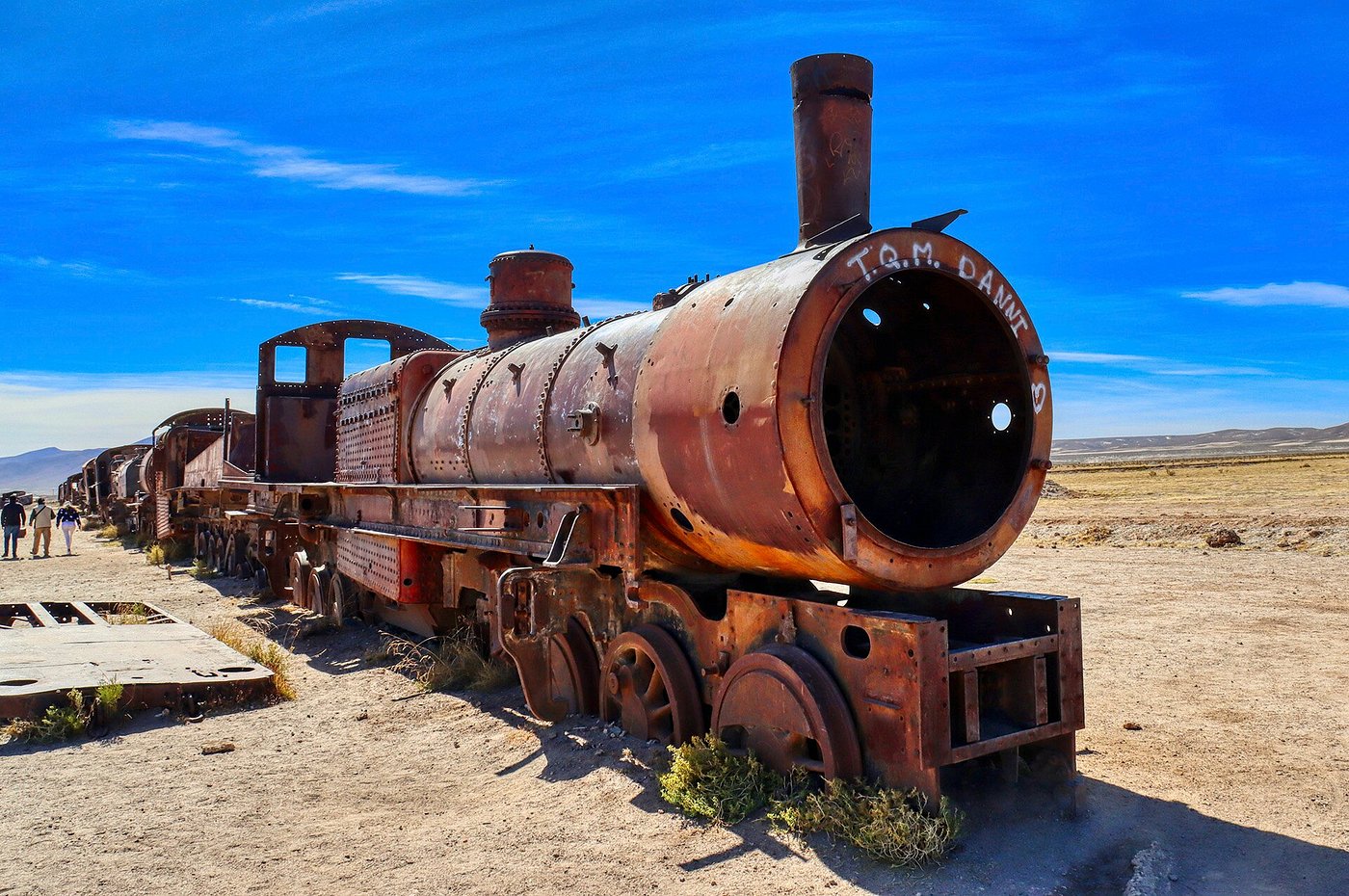
A short drive west of the dusty town of Uyuni, where the Bolivian Altiplano stretches towards the white, horizon-swallowing mirage of the Salar de Uyuni, a cluster of rusting locomotives sits stranded on a length of dead track. Their boilers gape like ribcages, their wheels are half-swallowed by salt-crusted earth, and their ironwork is tattooed with graffiti and the scrawl of itinerant artists. This site has become known as the Cementerio de Trenes, or the Uyuni Train Cemetery, at once an open-air museum, an industrial grave, and one of the most photogenic relic fields in South America. It is a place where a century of ambition and disappointment has settled into iron and dust, and where travellers step across coupling rods and climb into driver’s cabs to feel, for a moment, the weight of the continent’s railway dreams.

From Nitrate Dreams to Steel Arteries
The story of the train cemetery begins not with abandonment, but with vision. In the late nineteenth century, Bolivia—landlocked after its loss of coastline during the War of the Pacific—sought to redraw its economic map. British, Chilean, and Bolivian capital flowed into railway concessions designed to pipe minerals from the Andean interior to Pacific ports. Uyuni, founded in 1889 as a railway junction and military outpost, emerged as a crucial node on the Antofagasta–Bolivia Railway, which linked the high plateau’s silver, tin, and later zinc deposits to ships and global markets.
Steam locomotives hauled wagons across the salar’s edge and up difficult gradients, conquering both altitude and distance. Their presence was transformative. Towns acquired depots and workshops; telegraph lines followed the rails; timetables brought a rhythm to settlements accustomed to the seasons rather than the hour. The engines themselves were an international cast: British-built 2-8-0 Consolidations from firms like Beyer, Peacock & Co., compact tank engines designed for shunting in Uyuni’s yards, and heavier mainline machines capable of tackling the thin air above 3,600 metres. For decades, the railway was not only a conveyor of ore, but a spine that supported mail, passengers, and the movement of ideas.

Nationalisation, Headwinds, and the Long Fade
The mid-twentieth century altered the landscape as surely as a landslide. After the 1952 Bolivian National Revolution, the mines and the railways were nationalised, and the state took on the complicated inheritance of ageing infrastructure and volatile commodity markets. Diesel traction began to supplant steam, workshops modernised unevenly, and the economics of maintenance tilted against the oldest machines. Global demand for certain minerals softened, coastal routes shifted, and trucking captured traffic on improved roads that promised flexibility the railway could not easily match.
Uyuni retained its strategic significance but acquired a growing surplus of retired iron. Locomotives that had once thundered across the altiplano were shunted to the margins, cannibalised for parts, or simply parked and forgotten. In a dry climate that slows decay yet cannot halt it, they entered a second life as hulks and silhouettes. Over time, a loosely defined boneyard coalesced into what people began to call the train cemetery, an informal collection of dozens of engines, boilers, tenders, and wagons spread along old sidings and embankments at the desert’s edge.

Anatomy of a Boneyard
To the casual visitor, it is a jumble of metal. To the mechanically minded, it is a taxonomy of steam. You step from one relic to another, tracing the evolution of form: the squat saddle-tank engines with their water jackets perched atop the boiler, the longer tender engines with their graceful frames, the beltpacks of rivets stamped like constellations across domes and smokebox doors. The oversized buffers and hook couplers evoke a British lineage, while the tall chimneys and sand domes speak to mountain railroading techniques. Many cab sides still bear painted numerals, and the ghosts of livery beneath layers of oxidation. Footplates, once polished by boots and oil, are now abraded by salt and clumsy climbs. Gauges are smashed or missing; firebox doors hang ajar like metal eyelids.
The wagons are no less eloquent. Timber-sided flats lie twisted, their planks silvered by sun and wind. Boxcars yawn open to reveal emptiness where sacks of ore and casks of supplies once rode. The wheelsets are half-buried in a crust that blurs the boundary between track and desert. It is an industrial archaeology without fences or glass cases, and that accessibility—at once thrilling and problematic—lets the visitor feel the dimensions of these machines with hand and foot rather than eye alone.

Salt, Sun, and the Aesthetics of Decay
The setting amplifies the drama. At over 3,600 metres, the air is astonishingly clear, the ultraviolet intense, and the temperature seesaws between daytime warmth and night-time chill. The nearby salt flat is a geological mirror that leaches moisture from the wind and dust from the track bed. In this high desert, corrosion behaves differently than on a damp coast; it is less a quick devouring than a slow burn, producing rich ochres, maroons, and deep rust blacks that photographers love. The shadows cast by piping and handrails are hard-edged, the sky an enamelled blue, and the locomotives look both monumental and fragile, as if a push might topple them or a storm might scour them clean.
At sunrise the cemetery feels unpeopled and sober, the iron cold, the wind insistent. By late afternoon the place becomes theatrical, with long shadows slashing across boiler shells and tourists threading between them, their silhouettes briefly perched atop cab roofs for a triumphant photograph. When rain visits in the wet season, a thin film of water can gather in shallow ruts, turning the ground into a mirror that doubles the drama and nods towards the Salar’s famed reflective effect.

From Railway Junkyard to Tourist Pilgrimage
No one planned the train cemetery as an attraction. Its prominence emerged organically with the rise of Salar de Uyuni tours, which began to stitch the site into one-day and multi-day itineraries departing from Uyuni. Word of mouth, then social media, carried images of rust and sky, and a stop at the cemetery became a prelude to the salar’s boundless white. Local guides wove stories about the locomotives, mixing hard fact with good patter. Visitors arrived by the busload, and the cemetery’s role shifted from forgotten depot to stage set.
This transformation has been double-edged. Tourism has brought income to Uyuni, supporting drivers, mechanics, cooks, and hotel staff. It has also exerted pressure on an unfenced heritage site. Climbing on the engines, while practically irresistible, accelerates wear and invites falls and injuries. Metal scavenging, once intermittent, became more tempting when scrap prices spiked. Ad hoc graffiti ranges from exuberant to destructive, and while some of it verges on public art, not all visitors agree on where expression ends and vandalism begins.


Memory, Identity, and the Politics of Preservation
If the cemetery were simply a playground of iron, it would be easier to manage. But it has become a symbol of Uyuni and, more broadly, a vessel for Bolivia’s industrial past. The locomotives remember an era when the railway was the nation’s connective tissue, and they serve as material witnesses to debates about state investment, private capital, and the promises and compromises of modernisation. Preservation, therefore, is not just a technical problem of stabilising metal but a cultural question of what story to tell and how to tell it.
Efforts have been proposed and periodically undertaken to create interpretive signage, designate certain locomotives as exhibits, and limit climbing. Some engines have been repositioned to create coherent vistas, and a few pieces have been given rudimentary conservation such as welded braces or painted protective coats to slow deterioration. A small number of artefacts have migrated to more formal settings, including railway museums elsewhere in Bolivia, but the magnetism of the cemetery lies precisely in its lack of glass barriers. As a result, any preservation strategy must balance openness with stewardship, a tension felt in industrial heritage sites across the world.

Practicalities of a Visit
For most travellers, the cemetery is folded into a broader exploration of the Salar de Uyuni, often visiting in the morning or late afternoon. The site is roughly three kilometres from Uyuni town, accessible by vehicle or even on foot with appropriate care for altitude and sun exposure. At this elevation, hydration, sunscreen, and a hat move from optional to essential. The ground is uneven, rails and sleepers protrude, and the metal surfaces can be slick with dust or unexpectedly hot under strong sun. Good shoes make the difference between an eager scramble and a hesitant tiptoe.
There is an etiquette to photographing here that sits somewhere between courtesy and common sense. The most striking compositions rely on clean lines and leading curves, which are quickly spoiled by crowds. Sharing the space and waiting for a moment of emptiness rewards the patient. Inside cabs and tenders, it pays to step lightly and avoid dislodging loose parts. Drones, if permitted by local regulations and guides, should be flown thoughtfully; the engines deserve more than a noisy box buzzing a few metres from a stranger’s ear.


Reading the Machines
A visit becomes richer when you begin to read the machines themselves. The big driving wheels speak to power and speed potential, while the arrangement of cylinders and valve gear hints at the design choices of their builders. British export engines were often conservative, favouring reliability in harsh conditions over experimental flair. You can trace the path steam took from boiler to cylinder to exhaust, and imagine the coalman’s rhythm at altitude, where the fire demanded more attention as oxygen thinned and grades steepened. In the ash pans and along the track bed, cinders have commingled with desert silt, creating a soil unlike any garden earth, infused with the memory of combustion.
One of the cemetery’s most compelling paradoxes is that these engines, built to move, are arresting precisely because they no longer do. Their stillness allows the eye to absorb details always blurred in motion: the fillets where plates meet, the stipple of casting flaws, the elegance of a handrail’s curve. They are sculptures now, though they were never intended as such, and the sun has become their curator, reshaping them hourly with light.
Beyond Nostalgia: What the Cemetery Teaches
It would be easy to indulge only in nostalgia here, to imagine that Bolivia’s railway age was a lost golden era and that the cemetery is its elegy. Yet the site also prompts a more nuanced reflection on technology’s life cycle and the ethics of resource extraction. The engines worked for mining economies whose benefits and burdens were unevenly distributed. The railway brought connection but also dependence on distant markets. The cemetery, in its raw honesty, invites visitors to consider what happens when systems outlive their purposes, and how communities reinvent themselves when the steel arteries no longer pulse.
Uyuni has, in its way, done precisely that. The salar’s surreal beauty and the train cemetery’s post-industrial charisma have combined to create a tourism engine that feeds the town much as ore once did. Hotels, restaurants, outfitters, and guides form a contemporary network of livelihoods. There is pride in showing visitors these iron giants and pride, too, in knowing that the landscape can hold both an ancient salt sea and a modern itinerary.

The Future of the Iron Field
Looking ahead, the long-term fate of the Uyuni Train Cemetery will hinge on decisions made locally and nationally about heritage and development. A minimal intervention approach could allow the site to continue decaying gracefully, its meaning deepening as iron returns to earth. A more active plan could stabilise selected locomotives, provide interpretation in multiple languages, and create safe vantage points while leaving others untouched as true ruins. The best outcomes will likely blend the two, respecting the cemetery’s rough authenticity while acknowledging the needs of safety, education, and sustainable tourism.
Whatever course is chosen, the cemetery’s power lies in its ability to compress time. To stand among these machines is to feel the nineteenth century reach into the present, to sense the breathless labour of stokers and drivers, to hear an echo of wheels striking joints in the rails, and to recognise—under the Bolivian sun—that human ambition leaves traces as beautiful as they are brittle.
Conclusion
The Uyuni Train Cemetery is more than a curiosity on the way to a famous salt flat. It is a chapter of Bolivian history written in rivets and rust, a landscape of technology made strange by time and altitude. Its locomotives, poised forever between motion and memory, invite contemplation and reward imagination. Visitors come for the photographs and stay longer than expected, surprised by how eloquent abandoned machines can be. In a world that often bulldozes its past or vitrifies it in showcases, Uyuni has, perhaps unintentionally, offered a middle path: a place where history breathes through broken gauges and open fireboxes, and where the wind narrates a story of rails that once bound a nation to the sea.


