
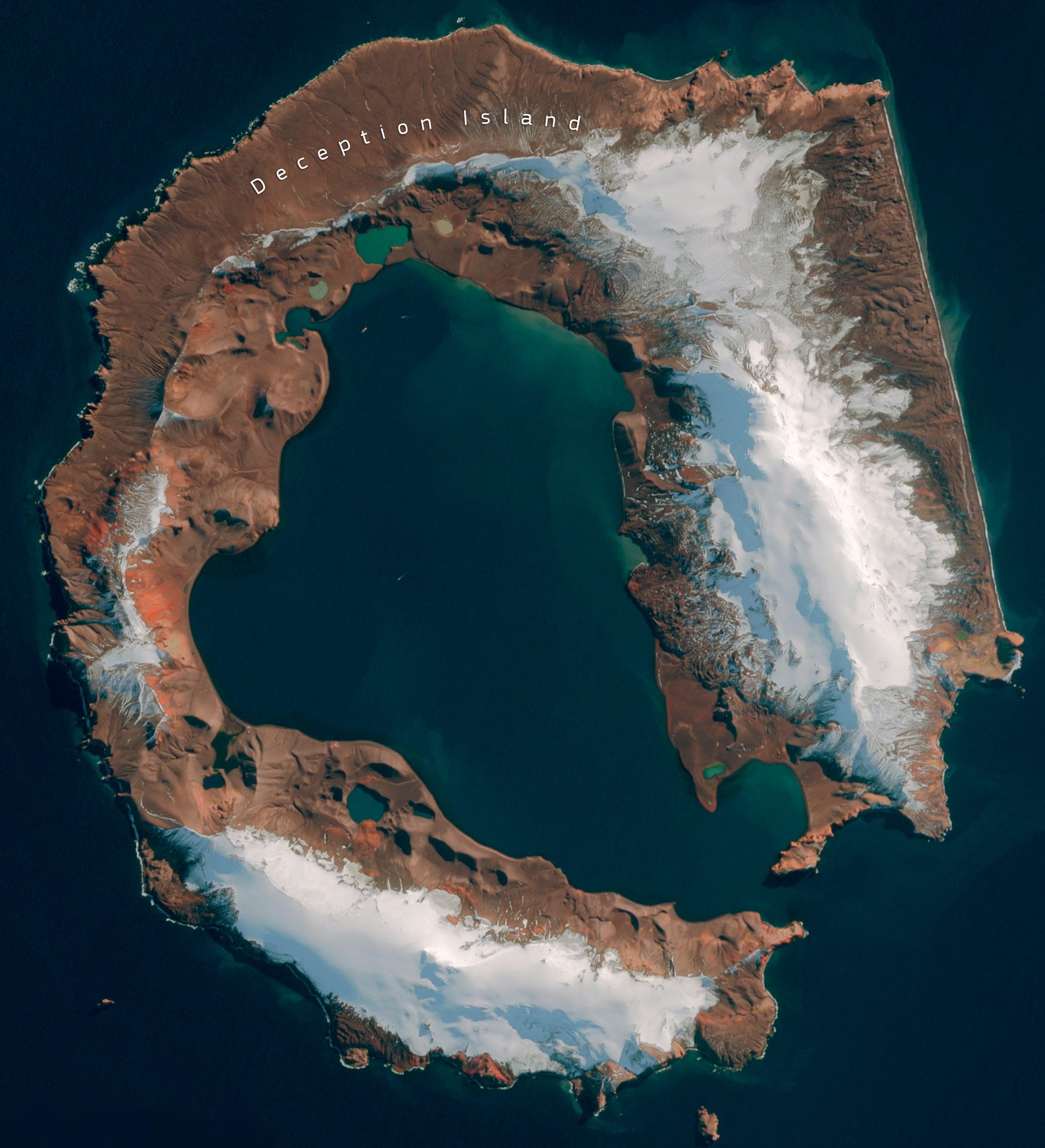
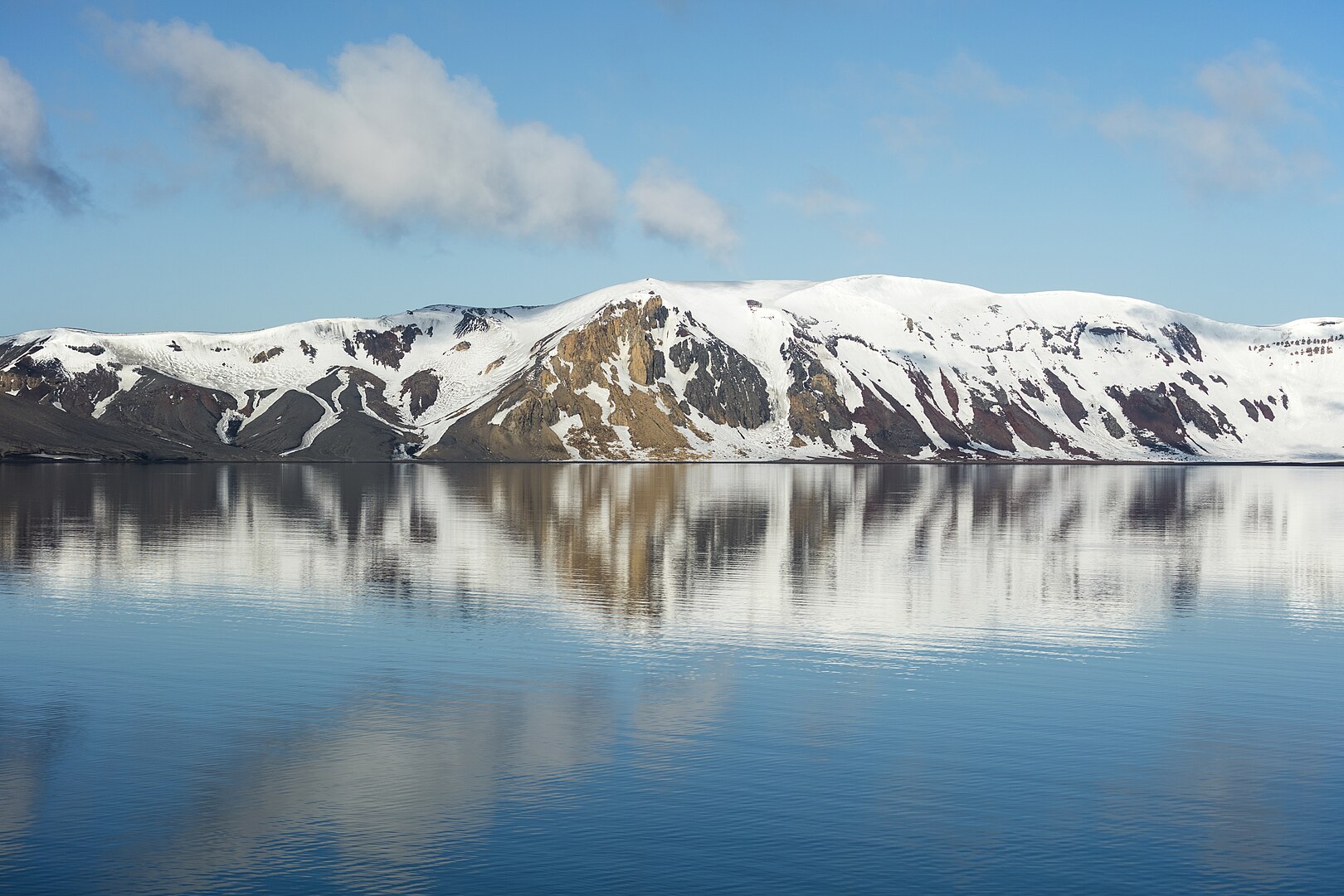
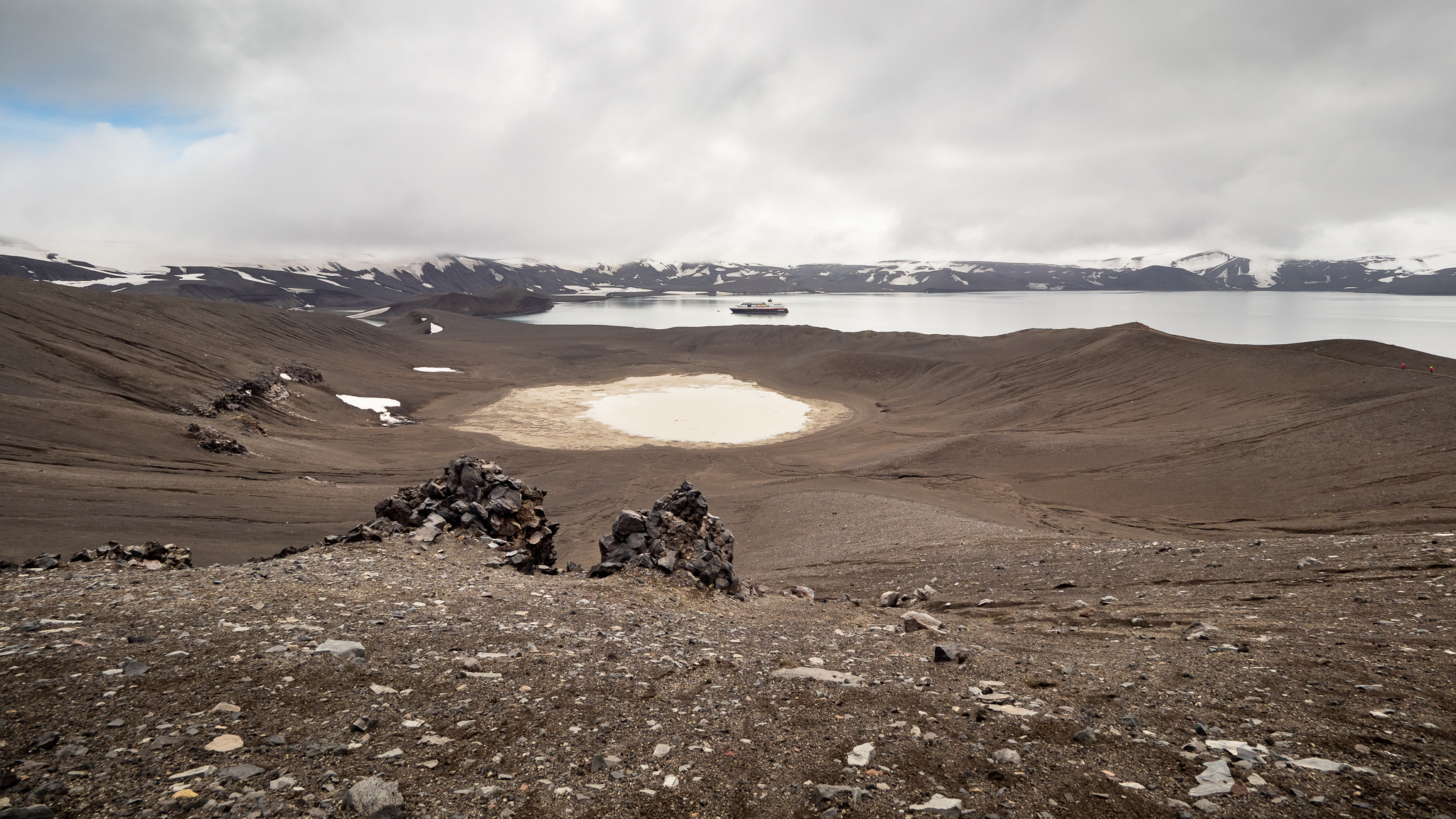
Whalers Bay lies just inside the narrow, treacherous entrance to Deception Island, a flooded volcanic caldera in the South Shetland Islands off the tip of the Antarctic Peninsula. Ships approach through Neptune’s Bellows, a kinked channel pinched by black cliffs and swept by fickle winds. The channel is barely wide enough for a modern expedition vessel and hides shoals that have embarrassed more than one captain. Once through, the sea spreads into Port Foster, the circular lagoon formed when the island’s lofty volcano collapsed into itself. Along the northeast inner shore, where geothermal warmth seeps through cinders and steam often threads the air, Whalers Bay curves in a long crescent of ash-grey beach. It is a place where history has not so much been preserved as abandoned in situ, and where the landscape itself keeps telling and retelling the story.
A Natural Harbour Forged by Fire
Deception Island is one of Antarctica’s very few active volcanoes and perhaps its most dramatic. The encircling land is the rim of the caldera; the bay is a breach in that rim; and Port Foster is the water-filled heart. Lava flows, cinder cones and fumaroles are common, and the sand can feel unexpectedly warm underfoot—even on days when the air bites and sleet rattles on jacket hoods. The geothermal gradient, though modest at the surface, is enough in places to thaw permafrost, nurture small patches of specialised mosses and create thin tendrils of steam that drift across the beach. The same warmth once helped whalers with the messy business of flensing and rendering, and it continues to shape both the ecology and the human footprint.
From Seals to Sperm Whales: The Commercial Rush South
The bay’s modern story begins with exploitation. In the early nineteenth century, sealers ranged the South Shetlands and left little but silence in their wake as populations of fur seals were hammered to near collapse. A century later, a new extractive frontier opened. The circumpolar seas teemed with baleen and sperm whales, and the demand for whale oil—used in everything from lighting and lubrication to margarine and glycerine—drove an industrial migration south.
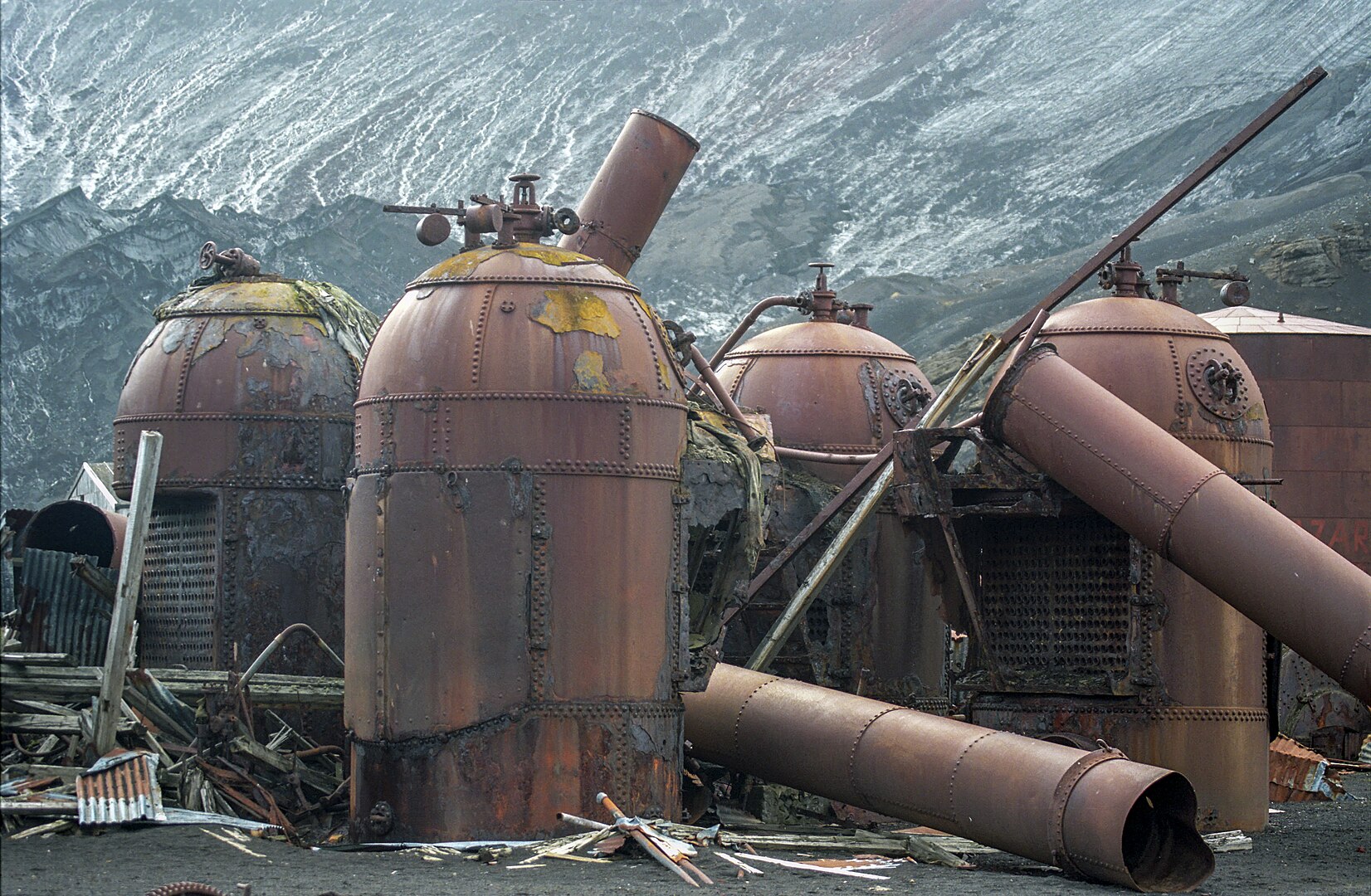
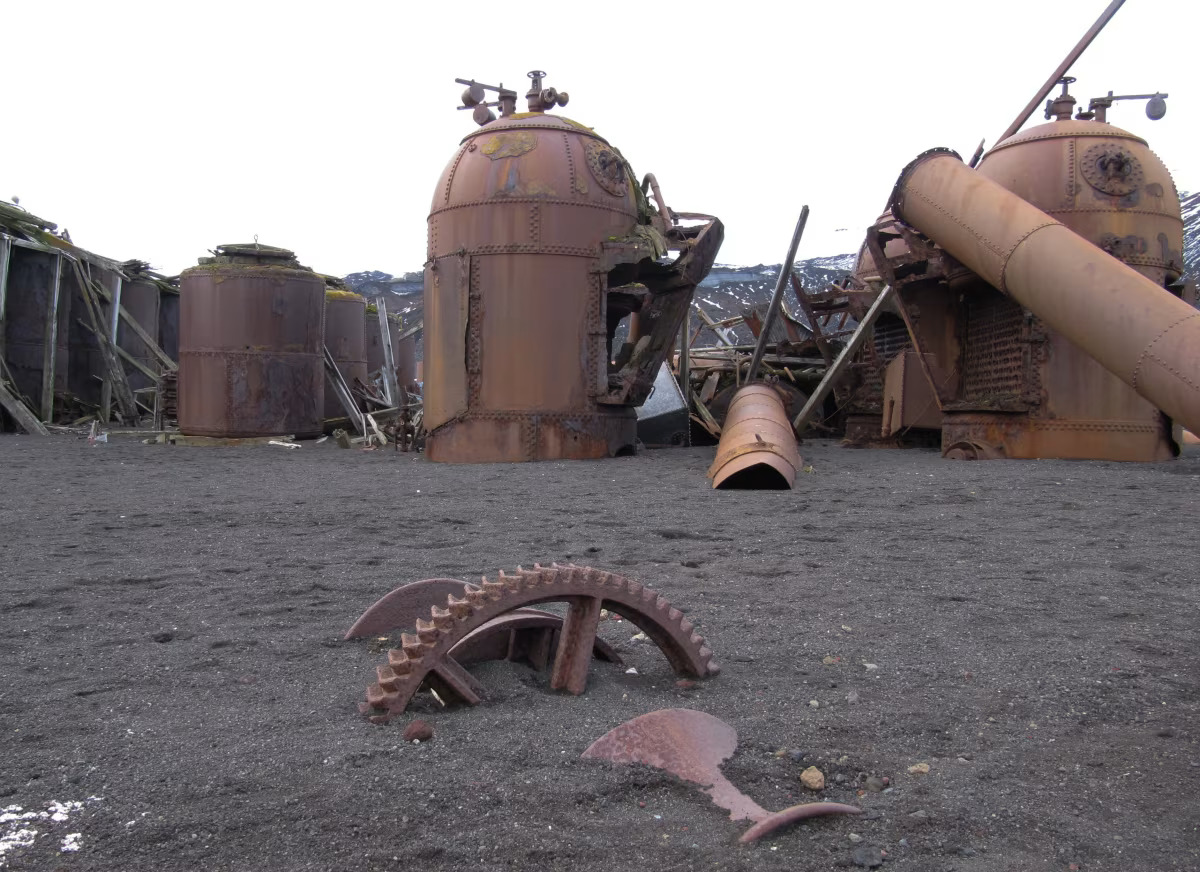
Whalers Bay became one of the Antarctic’s busiest shore stations when Norwegian interests, among others, established the Hektor Whaling Station in the 1910s. The site was ideal by the brutal arithmetic of the trade. The caldera offered a vast, sheltered anchorage even when the Southern Ocean grew mean. The gently shelving beach was long enough for slips and workshops. What little warmth percolated through the volcanic ground made certain maintenance tasks easier in a climate where steel can feel brittle and fingers lose dexterity almost at once. Through the austral summers, factory ships and catchers crowded the lagoon, their silhouettes punctuated by cranes, derricks and cookers. Oil tanks were clustered behind, a line of staved cylinders now rusted into dramatic ochre shells.
Working conditions were harsh and relentlessly physical. Men spent months in perpetual daylight, their circadian rhythms unsettled, their clothes stiff with salt and grease. The ghosts of that labour linger in the skeletal ribs of boilers and the collapsed frames of wooden water boats. On foggy days the bay feels like a negative of its own past: solid forms gone, outlines remaining.
Abandonment and Interlude: From Flensing Knife to Flag
The commercial station did not last. Market fluctuations, international regulation and the rising efficiency of pelagic factory ships made shore-based whaling economically precarious. By the early 1930s, Whalers Bay’s industrial clamour had faded into the surf. Yet Deception Island did not recede from human affairs. Instead, it shifted roles from outpost of extraction to node in the geopolitics of science and sovereignty.
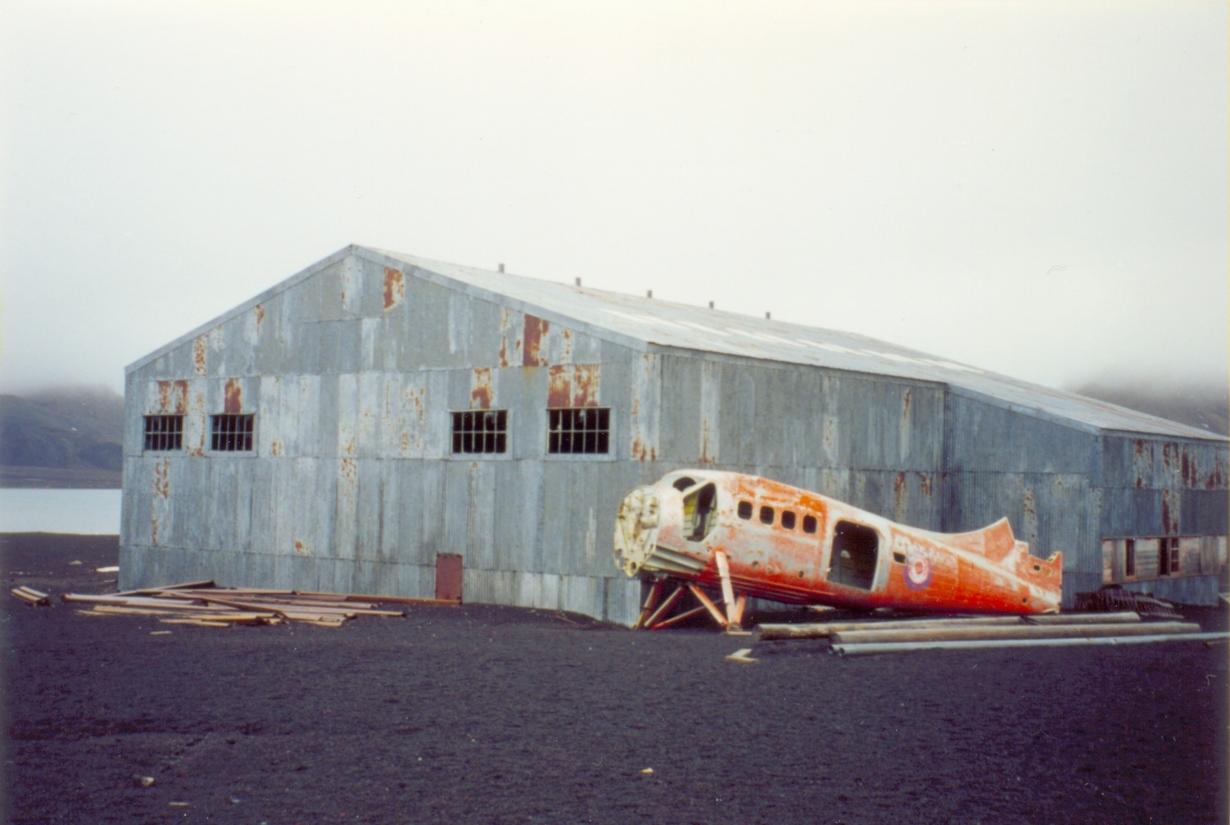
During the Second World War, Britain initiated Operation Tabarin to maintain a presence in the region and gather meteorological and geographic information. After the war this effort evolved into the Falkland Islands Dependencies Survey, later the British Antarctic Survey. At Whalers Bay, Base B was established amid the abandoned whaling plant. New timber buildings rose beside old iron tanks; radio aerials hummed where flensing yards had echoed; and a hangar appeared on the ash to support aerial survey and logistics. For a time, the island hosted a modest but significant programme of mapping, geology and meteorology, part of a broader international intensification of Antarctic science that culminated in the International Geophysical Year of 1957–58.
Other nations, notably Chile and Argentina, also operated in the archipelago and on Deception Island itself. The South Shetlands thus became one of the most densely occupied corners of the Antarctic during the mid-twentieth century, not with towns or ports as elsewhere on Earth, but with small, seasonal encampments where flags fluttered above snow fences and windbreaks.
The Volcano Reminds Everyone Who Is in Charge
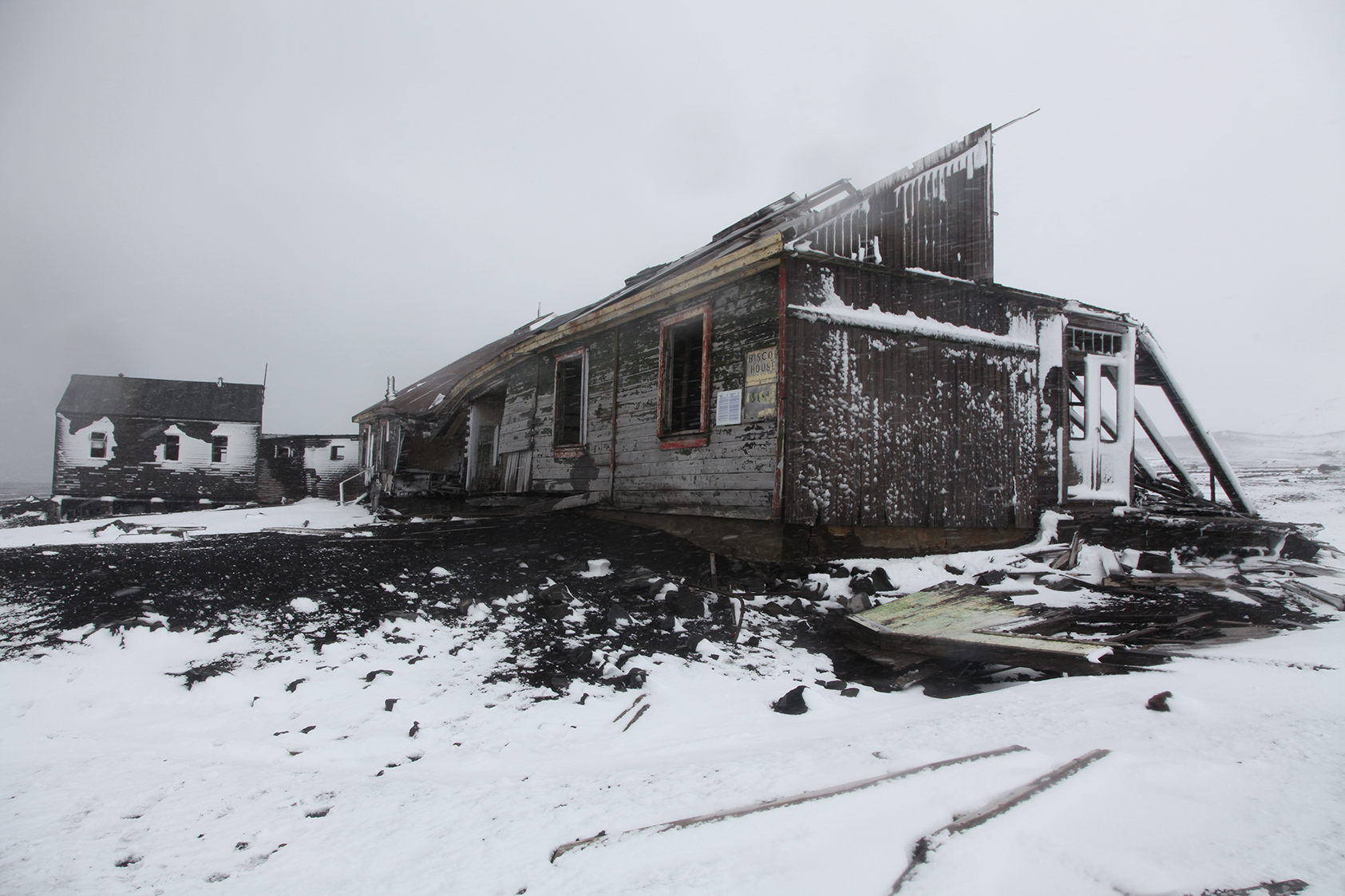
All of these plans were hostage to geology. Deception Island’s volcano had dozed through the whaling years, but dormancy is not the same as extinction. In 1967 a series of eruptions rent the caldera floor and flung ash and pumice across the bay. Mudflows, ash fall and flooding damaged or destroyed scientific bases and reshaped parts of the shore. The British evacuated and later reoccupied, only to be forced out again by further eruptive episodes in 1969 and 1970. At Whalers Bay, lahar deposits swept low-lying structures; timbers were twisted, corrugated iron bent and torn, doorways jammed shut by displaced ground. The island imposed a pause, and the pause became permanence.
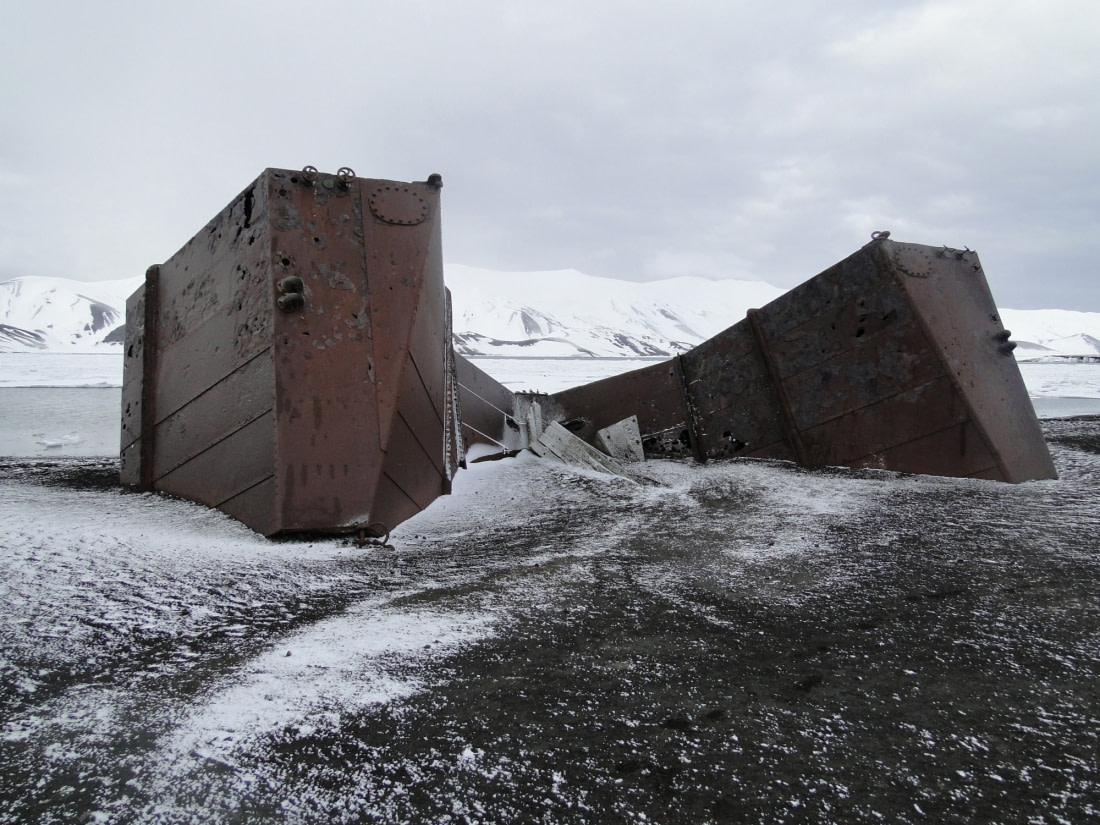
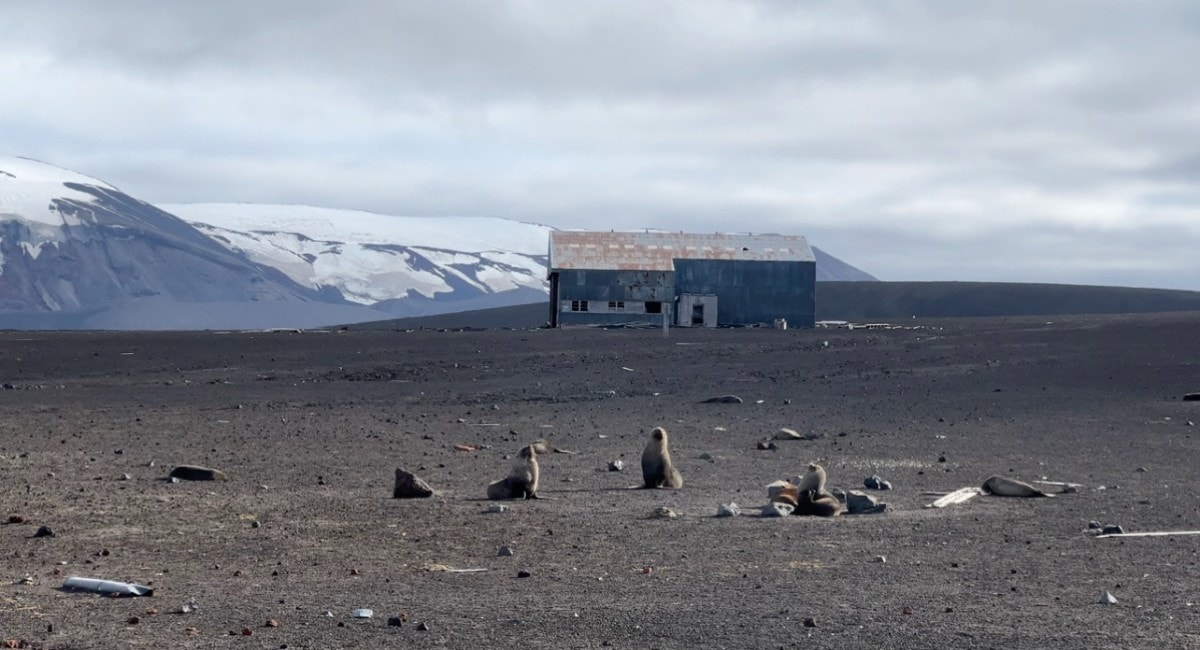
Today the remains of Base B and the earlier whaling station are among Antarctica’s most evocative industrial and scientific ruins. A hangar stands like a rusted cathedral nave open to the weather. Oil tanks, punctured and flaking, are lined up like drums in a drowned parade. The cemetery that once held the graves of whalers and explorers suffered in the eruptions, a stark reminder that even memorials are provisional on an island where the earth moves.
Heritage in a Place Without Owners
Under the Antarctic Treaty System, Whalers Bay is recognised as a historic site and monument. The designation is less about enshrining prettiness than about safeguarding a difficult past. The remains are not sanitised exhibits; they are working ruins, fragile and meaningful precisely because they have been left where they fell. Management plans prescribe how visitors should move, what structures must not be entered and how groups should avoid trampling the delicate geothermal flora. The same plans commit nations to stabilising certain elements while resisting the temptation to tidy up to the point of amnesia.
This approach accords with the wider philosophy of Antarctic heritage, which acknowledges that the continent’s human story is thin in population but dense in symbolism. Whalers Bay embodies the contradictions: discovery and damage, science and sovereignty, courage and cruelty. To walk between the tanks is to step through overlapping eras of Southern Ocean history.
Wildlife and the Living Present
Despite its industrial past, Whalers Bay is not a dead zone. In summer, chinstrap penguins patrol the waterline in purposeful files, their calls echoing off the cinder slopes. Kelp gulls and skuas keep a watchful tally of anything edible. Seals—Antarctic fur seals, Weddells and the occasional elephant seal—haul out on the darker, warmer patches of sand, turning like clock hands to present different flanks to the fitful sun. Offshore, the blow of a humpback or minke may mark the continuation of a story that has changed in content if not in characters: watching rather than hunting now dominates the human–whale encounter here.
The geothermal microhabitats encourage a sparse but resilient flora of mosses, liverworts and lichens. These communities are sensitive to trampling, hence the careful zoning of landing beaches and the marked paths between structures and lookouts. Even a footprint can last all season in the wrong substrate, and the recovery of crushed moss may take years, a timescale that calls for patience in a world used to instant repair.
Tourism, Risk and the Allure of Ruins
Whalers Bay is one of the Antarctic Peninsula region’s most visited landing sites for expedition cruises. Several factors conspire to make it so. The setting is theatrically strange. The approach through Neptune’s Bellows sharpens the senses. The ruins are photogenic in a way that raises interesting questions about taste and memory. And there is always the frisson of the active volcano, reinforced by the occasional wisp of steam rising behind a tank or from a fissure near the tideline.
Visitor guidelines are explicit. Certain buildings are off-limits because their roofs and floors are unsound and because asbestos remains present in older materials. The hangar, though irresistible as a subject for photographers, should be treated with great respect, and entry is usually prohibited. Artefacts that seem to invite handling—old pipes, staves, tools—must be left exactly where they rest. Swimming, sometimes advertised as a “polar plunge,” is neither encouraged nor outlawed, but sensible operators emphasise caution. The beach can be deceptively warm at the surface and startlingly cold in the wash; the temperature gradient can numb judgment as effectively as the water numbs fingers.
The site is also a place of noise even in calm weather. Wind funnels through the bay and thrums in the guy lines of derelict masts. Corrugated sheets drum, clank and complain. When fog drops, the ruins appear and vanish at short range, and for minutes at a time one can be alone with a tang of sulphur and the creak of old iron.
Reading the Ruins
The remains repay patient attention. The line of stanchions that once supported the flensing platform shows the scale of the work. The foundation bolts of long-vanished tanks mark the site’s geometry. A twisted rail hints at how a lahar scoured the beach. The cylindrical boilers, speckled with salt and oxidation, still carry onion-skin layers of rust that flake like bark. A weathered wooden boat, storm-bleached and half-buried, looks as if one more storm will complete its return to the elements. Every object says something about logistics in a place without timber, about improvisation in the face of shortage, and about how quickly industry can be overtaken by both economics and geology.
A short climb up the cinder slope behind the station yields a wider view. From there the curve of the beach becomes clear, and the position of the station makes functional sense: easy access to deep water, a lee from prevailing winds, a modest buffer from surf. The surrounding ridges, often patched with snow even at the height of summer, reveal the inward tilt of the caldera ring. It feels like standing inside a broken bowl.
Science Continues, Though Differently
While Whalers Bay itself is now primarily a heritage and visitor site, Deception Island remains of scientific interest. Geologists monitor ground deformation, seismic tremors and thermal anomalies to better understand the volcano’s restlessness. Biologists study microbial mats and plant communities that thrive in the warm soils. Oceanographers use the caldera as a natural laboratory for circulation and mixing in a semi-enclosed polar basin. The larger lesson is that Antarctic science is not confined to huts and instruments; the landscape itself is an active partner, and sometimes, as the eruptions showed, the senior partner.
Ethics at the End of the World
It is tempting to romanticise Whalers Bay, because ruins invite narration and the Antarctic light tends to make everything look noble. Yet the place resists any easy sentiment. Whaling was a bloody business that drove several species to the brink; the scrap and rust are material witnesses to that exploitation. At the same time, the subsequent scientific presence laid foundations for the international cooperation that distinguishes the Antarctic Treaty era. The bay, then, is not one story but a palimpsest, and responsible visiting means reading all the layers, not just the picturesque ones.
Practical Impressions for Those Who Go
Most visitors arrive between November and March on small expedition ships that can safely enter Neptune’s Bellows. Landings depend on weather, sea state and local conditions. Underfoot, the ash can be loose and uneven; waterproof boots are essential, and hands-free walking sticks help on the cinder slopes. On cold, windy days the geothermal patches are a curiosity rather than a comfort, but kneeling and pushing a hand into the sand may still draw a little heat and a curl of steam. The smell of sulphur is sometimes present but rarely strong. Guides will explain the site’s zoning and the reasons for it; following their lead is not mere decorum but a contribution to the site’s long-term survival.
Photography is irresistible, but the most valuable souvenir is a sharpened sense of context. The tanks and boilers are not props; they are artefacts left where work once consumed seasons of human effort. The hangar is not an Instagram frame; it is a vulnerable heritage structure that has already outlived its designers’ expectations thanks to restraint more than intervention. Even the small clumps of moss beside a warm crack in the sand are not generic greenery; they are slow-growing outposts that push quietly against the planet’s limits.
A Bay That Holds Its Own Counsel
In the end, Whalers Bay is powerful because it feels unfinished. The island is not done erupting. The iron is not done rusting. The sea is not done with its long, patient grind. Human traces here are both stubborn and fragile, as likely to be erased by a single storm or mudflow as to persist for decades. The sight of a zodiac nosing ashore against a line of corrugated iron, the cackle of a skua circling, the distant sound of brash ice sloshing against the hull—these are contemporary experiences layered onto a place that refuses to resolve into one meaning. To stand on that ash and watch steam thread from the beach into cold air is to recognise that Antarctica rarely offers closure. It offers, instead, an invitation to think with places that change slowly until they suddenly do not, and to hold more than one truth at once.
Whalers Bay rewards those who accept the invitation. It is, at heart, a lesson in humility written in cinder and salt, in iron and ash, at the ragged rim of a sea-filled volcano.


