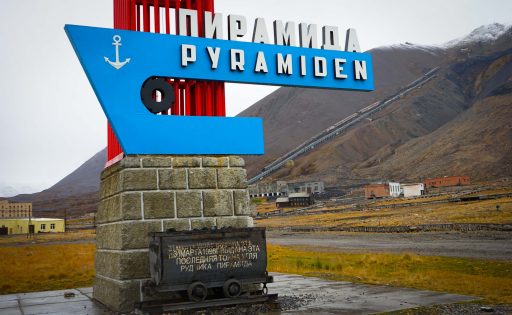
On the southern shore of Isfjorden, on the island of Spitsbergen in Svalbard, lies a quiet bay that once hummed with locomotives, cranes and the clatter of coal wagons. Coles Bay – known in Norwegian as Colesbukta – is today an abandoned Soviet-era mining settlement, a scattering of decaying buildings and twisted metal framed by Arctic mountains and sea ice. What survives there now is not just rusting machinery, but a remarkably vivid trace of Svalbard’s coal age and the geopolitical ambitions that came with it.
The Setting: An Arctic Harbour on Isfjorden
Coles Bay is a broad, gently curving bay about four and a half kilometres wide on the southern side of Isfjorden, in Nordenskiöld Land on Spitsbergen. A valley, Colesdalen, opens into the bay, and low hills rise into the interior of the island. The location is strategically important: Isfjorden is one of Svalbard’s largest fjords, offering deep, relatively accessible water for ships and a gateway towards the Barents Sea and the Russian mainland beyond.
The climate is harsh even by Arctic standards. Long months of darkness, winter temperatures often well below freezing and frequent storms shaped not only daily life for residents but also the design of the settlement itself, from protective structures over the railway to heavily insulated housing. Industrial archaeology studies of Svalbard’s mining communities have highlighted how isolation, permafrost and polar night were treated as engineering challenges, but also as factors in social planning.

From Whaling Cove to Coal Bay
Long before coal miners arrived, Coles Bay was used seasonally by European whalers. The bay’s sheltered waters and access to rich whaling grounds made it a useful anchorage in the 17th–19th centuries, part of the broader pattern of exploitation that first drew people into Svalbard’s brutal environment.
In the late nineteenth and early twentieth centuries, attention began to turn from whales to coal. Geological surveys and prospecting expeditions documented substantial coal seams along the shores of Isfjorden. Early attempts at mining in the Coles Bay area were modest and sporadic, but they foreshadowed the more ambitious operations that would follow once capital and political will aligned.
Vladimir Rusanov and the First Russian Claims
The figure most closely associated with the birth of Coles Bay as a mining locality is the Russian geologist and explorer Vladimir Alexandrovich Rusanov. In 1912 he led a Russian expedition that surveyed several parts of Svalbard for coal, visiting fjords and valleys including areas around Isfjorden. During this work, his team established a small cabin at the entrance to Coles Bay and laid claim to coal fields in the region.
This cabin, often called Rusanovodden or Rusanoffhuset, became the headquarters of his Svalbard activities. Rusanov himself disappeared the following year during an Arctic expedition, but his cabin remained. In time it would be preserved as a simple, self-guided museum, commemorating both his exploration and the beginning of Russian coal interests in the bay. Today, travellers can still sleep there; the hut is one of the few publicly accessible cabins on Svalbard, offering bunks, a stove and a compact exhibition of Rusanov’s story.

Building a Soviet Port: Grumant and Coles Bay
Commercial exploitation of the coal claims took shape in the early decades of the twentieth century. A succession of Russian and Anglo-Russian companies worked to develop mines in the nearby settlement of Grumantbyen – usually known simply as Grumant – situated further along the coast. Coles Bay, with its more favourable harbour conditions, was chosen as the export port for Grumant’s coal.
After the Russian Revolution and the 1925 Svalbard Treaty, which granted Norway sovereignty over Svalbard while allowing other signatory states rights to engage in commercial activities such as mining, Soviet interests were consolidated under the state-owned mining enterprise Arktikugol (“Arctic Coal”). Arktikugol eventually controlled Russian operations at Barentsburg, Pyramiden, Grumant and the port at Coles Bay, embedding the settlement firmly in the wider network of Soviet coal outposts in the High Arctic.
A narrow-gauge railway, around six kilometres long, was constructed between Grumant and Coles Bay to carry coal from the hillside mines down to the harbour. Much of the track ran inside long wooden galleries designed to protect both rails and wagons from snowdrifts and winter storms. Even today, remnants of the line and protective structures can be traced along the coast, one of the most visible pieces of industrial infrastructure connecting the two ghost settlements.
Life at the Edge: A Coal Community in the 1950s
At its peak in the early 1950s, the combined population of Grumant and Coles Bay reached just over 1,100 people, a substantial community by Svalbard standards. Many of the workers and their families came from Soviet regions such as Donbas and Tula, bringing with them not only mining expertise but also the cultural life of a mainland Soviet town transposed into Arctic conditions.
Coles Bay itself was primarily a working port rather than a large residential centre, but it had all the infrastructure needed to support coal export and harbour operations: warehouses, loading facilities, workshops, power supply, accommodation for harbour workers and technicians, and small service buildings. The rhythm of life was governed by the shipping season, the arrival of supply vessels and the constant movement of coal along the railway.
Daily existence was demanding. Winter darkness lasted for months, temperatures could fall below –15 °C, and powerful winds swept the bay. The industrial ruins visible today still suggest how much effort went into adapting to this environment: thick walls, small windows, elevated structures to cope with permafrost, and snow sheds over critical walkways and rails. Accounts and reconstructions of similar Svalbard mining towns show that, even in such conditions, residents attempted to create a sense of normality through social clubs, communal dining halls and cultural activities, though Coles Bay’s role as a port meant much of that social life took place up in Grumant itself.


Decline, Closure and Abandonment
By the late 1950s and early 1960s, several pressures were converging on Svalbard’s older coal operations. Coal seams near Grumant became harder and more expensive to exploit, and the combination of geological challenges, ageing infrastructure and changing economics of coal made the operation less viable. High operational costs and declining profitability prompted Arktikugol and Soviet authorities to reconsider the future of both Grumant and Coles Bay.
Mining operations at Grumant were gradually wound down, and with their closure Coles Bay lost its primary purpose as an export harbour. Most sources agree that industrial activities in Coles Bay effectively ceased in the early 1960s; Grumant was abandoned in 1965, while some accounts suggest that Coles Bay retained a small presence linked to exploratory drilling into the 1970s or 1980s before being fully deserted.
When the last Soviet workers left, they dismantled or destroyed parts of the industrial plant, both for scrap value and to prevent potential use by others. Photographs and field reports describe collapsed storage tanks, the remains of loading cranes and the shattered shells of buildings, some of which appear to have been demolished with explosives, leaving debris scattered over wide areas.

Ghost Port on the Fjord: The Site Today
Today, Coles Bay is a ghost settlement, classed as abandoned but still strikingly legible as an industrial landscape. Visitors arriving by small expedition ship or private boat typically land on a stony beach and climb past wooden sleepers, metal fragments and discarded machinery towards the scattered remains of the Soviet-era port.
The Rusanov cabin at the entrance to the bay, converted into a hut-museum, offers a rare intact interior space: bunks, stove, simple displays and notes about Rusanov and the history of mining in the area. It stands in sharp contrast to the ruined warehouses and industrial buildings deeper inside the settlement, their walls cracked and roofs collapsed under decades of frost, wind and neglect.
Among the ruins are smaller wooden houses, sheds and technical structures, many leaning at odd angles where permafrost movement has warped their foundations. The outlines of the railway embankment are still visible leading away towards Grumant, occasionally accompanied by preserved fragments of track or support posts from the protective galleries.
A small cemetery, with simple crosses and markers, lies slightly apart from the industrial core of the site, a reminder that this remote settlement was once a place where children were born, workers died and families grieved, just as in any other mining town.

Nature Reclaims Coles Bay
Despite the wreckage of industry, Coles Bay is far from lifeless. Reindeer graze among the derelict buildings, Arctic foxes patrol the scree and seabirds nest on nearby cliffs. In summer, the tundra around the bay is dotted with mosses and hardy flowering plants, and the long daylight floods across rusting machinery and the dark waters of Isfjorden.
The cold, dry climate of Svalbard acts as an inadvertent conservator, slowing the decay of wood and metal. This preservation has made Coles Bay, and other ghost settlements such as Pyramiden and Grumant, valuable case studies for archaeologists and historians of industrial heritage, who can see in situ the layout, materials and everyday objects of a mid-twentieth-century polar company town.
At the same time, the environmental legacy of coal mining is visible in disturbed ground, waste heaps and residual contamination. Svalbard’s authorities and researchers have increasingly considered how to balance the preservation of industrial heritage with protection of fragile Arctic ecosystems, a question that Coles Bay embodies very clearly.
Heritage, Geopolitics and the Future of Coles Bay
Coles Bay is not just a relic of industrial history; it also occupies a place in today’s shifting Arctic geopolitics. Arktikugol still exists as a Russian state-owned company and retains property rights in Coles Bay. In recent years, there have been intermittent proposals to revive activity there, including the construction of a road linking Barentsburg to Coles Bay and the potential reuse of buildings for research or logistics.
A 2025 report described renewed Russian interest in the area, noting new signage on site and applications concerning the reuse of abandoned structures. While actual coal extraction has not resumed, occasional scientific or maintenance presence and growing tourism have begun to weave Coles Bay into a new narrative of Svalbard’s future: one in which coal gives way to science, heritage tourism and strategic positioning in an increasingly accessible Arctic.
Any such development has to navigate the legal framework of the Svalbard Treaty, Norwegian regulations on cultural heritage and environmental protection, and the sensitivities around Russian activity in the archipelago. For now, Coles Bay remains largely untouched, a frozen snapshot of late Soviet industrial ambition on Norwegian soil.

Coles Bay in the Imaginations of Travellers
For modern visitors, Coles Bay is both scenic and unsettling. Expedition cruise operators sometimes include landings here, marketing the bay as a “Soviet ghost town” and a window into Svalbard’s coal-mining past. Travellers describe a surreal experience: walking past collapsed gantries and rusting winches while the midnight sun shines overhead, or standing on a silent pier where ships once loaded thousands of tonnes of coal bound for distant power stations.
The hut of Vladimir Rusanov, with its small museum, provides a human anchor for the story, linking the isolated ruins to a wider narrative of Arctic exploration, scientific ambition and the hazardous gamble of polar mining. Nearby, the cemetery and scattered personal artefacts – bottles, tools, fragments of furniture – hint at the ordinary, unrecorded lives that unfolded here: shifts in the mine, evenings in cramped barracks, children playing in the snow beside the tracks.
An Arctic Palimpsest
Coles Bay Mining settlement is more than an abandoned port. It is a layered record of whaling, exploration, early capitalist ventures, Soviet state industry and contemporary debates about heritage and geopolitics. In the warped sleepers of the railway and the wind-blasted shells of the coal loaders, you can read how far people were willing to go – geographically and politically – to extract energy from the Arctic.
Today the bay is quiet, but that silence is full of traces. In the museum hut of Vladimir Rusanov, in the scattered timbers of demolished buildings and in the soft tracks of reindeer across the old industrial yards, Coles Bay continues to tell its story: a small harbour at the end of the world, where coal, ideology and ice once met.