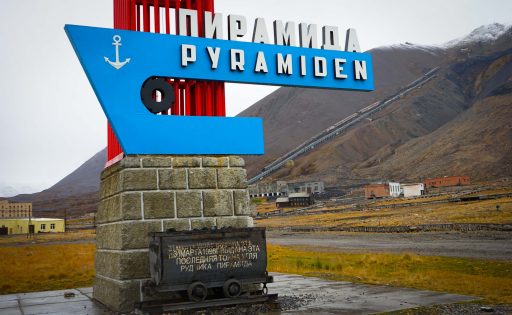
On the western coast of Spitsbergen, facing the cold waters of Isfjorden, the ruins of Grumant cling to steep slopes and eroding cliffs. Windows gape where glass once held back polar winds, rusted rails vanish into scree, and collapsing staircases trace the ghost of streets that once rang with Russian voices. Grumant, or Grumantbyen, is one of Svalbard’s most evocative ghost towns: a former Soviet coal mining settlement that rose rapidly in the early twentieth century and vanished almost as quickly in the 1960s.
Today, it stands as a frozen fragment of industrial ambition, Cold War geopolitics and everyday life lived at the very edge of human endurance.


Setting the Scene: Grumant in Svalbard
Grumant lies on Spitsbergen, the largest island in the Svalbard archipelago, roughly ten kilometres west–south-west of Longyearbyen, the modern administrative centre. Perched on steep terrain along the eastern side of Isfjorden, it occupies an awkward, narrow strip between sea and mountains. That geography shaped almost everything about the settlement: its layout, its transport links, and ultimately its fate.
Unlike some of Svalbard’s more gently sloping shore settlements, Grumant offered virtually no flat land for a port or large town square. There was no deep-water harbour directly below the mines, so coal could not be loaded efficiently onto ships at the settlement itself. Instead, Grumant was paired with nearby Colesbukta (Coles Bay), which developed into a logistical hub and port. A narrow-gauge railway linked the two, carrying coal from the steep mining site at Grumant down to the shore facilities at Colesbukta.
This division of functions – Grumant as mining centre and Colesbukta as harbour and housing – created a twin-settlement system that is unusual even among Svalbard’s many industrial outposts.

Origins: From Pomor Name to Anglo-Russian Enterprise
The name “Grumant” is of Pomor origin, used historically by Russian Pomor hunters and traders for the Svalbard region as a whole and possibly derived from a distorted form of “Greenland”, with which these distant Arctic lands were once confused. The modern mining settlement was established in the early twentieth century, part of the wider rush to exploit Svalbard’s coal resources.
Mining activity at Grumant is generally dated to 1912, when systematic operations began. In the 1920s the Anglo-Russian Grumant Company Ltd., headquartered in London, took a leading role in developing the site, reflecting the international character of Svalbard’s early coal ventures. The company even issued local banknotes for use within the settlement, underlining how remote and self-contained this Arctic community was; these notes have since inspired contemporary artworks that literally incorporate pulverised coal from Svalbard mines.
Over time, ownership and control shifted firmly into Soviet hands. Like Barentsburg and Pyramiden, Grumant became part of a network of Soviet company towns on Norwegian territory, operating under the framework of the Svalbard Treaty, which allowed signatory nations to engage in economic activity on the islands.

Building a Soviet Company Town in the Arctic
At its peak, Grumant was a fully fledged community rather than a simple mining camp. Together with Colesbukta, it supported more than a thousand inhabitants. In 1951 the combined population reached about 1,106 people, making it one of the major Soviet settlements on Svalbard, even if it ranked behind Barentsburg and, later, Pyramiden in long-term significance.
In an environment where imported labour had to be attracted and retained despite isolation, cold and darkness, the Soviet authorities invested in creating a recognisable slice of Soviet life. Housing blocks, communal facilities, cultural institutions and services were established to give miners and their families some sense of normality. Schools educated children, a clinic or small hospital provided medical care, and social and recreational spaces helped sustain morale through long polar nights.
Life followed the rhythms of Arctic industry: around-the-clock operations in the mines, shifts timed to the needs of production rather than daylight, and strong community reliance on communal dining halls, clubs and organised activities. The townscape, with its functional architecture and ordered layout, mirrored Soviet planning norms seen elsewhere in the Arctic, including Pyramiden and Barentsburg.

Coal, Cliffs and Covered Railways
Grumant existed because of coal. The mines exploited seams in the steep slopes above the settlement. Over the lifetime of the operation, an estimated two million tonnes of coal were extracted from the deposit. Yet the very topography that made the seams accessible also made the settlement difficult and expensive to sustain.
Because constructing extensive infrastructure directly at the shoreline was almost impossible, much of the processing and shipping infrastructure had to be located at Colesbukta, on more suitable terrain along the fjord. The two communities were connected by a narrow-gauge Decauville railway, with a track gauge of around forty centimetres. This line was famously enclosed within a long wooden structure – a covered conveyor-like gallery that protected coal wagons and workers from drifting snow, fierce winds and avalanches.
Coal mined at Grumant would be loaded into wagons, shuttled through this wooden tunnel to Colesbukta, and then transferred onto ships bound for Soviet ports or other markets. In particularly productive periods, Grumant helped contribute to hundreds of thousands of tonnes of coal shipped annually from Soviet-run settlements on Svalbard.
Despite these engineering solutions, the logistical disadvantages of Grumant – especially the lack of a deep-water harbour and the exposure of the site to erosion and landslides – remained a persistent problem.

Peak and Decline
The 1950s were the high point for Grumant. The settlement was busy, the mines were productive, and the Soviet presence on Svalbard was strongly established. Yet beneath this apparent stability, several pressures were building. Some coal seams were becoming harder or more dangerous to work, while other locations in the Soviet Union offered easier, cheaper extraction. Maintaining an ageing, remote community with complicated transport infrastructure was costly.
Official production declined towards the end of the decade. Mining at Grumant ceased around 1961–62; some sources describe the mine as having been closed in the summer of 1961, while broader historical overviews for Svalbard note Grumant’s closure after the deposit was considered depleted in 1962. Most accounts agree that the settlement itself was fully abandoned a few years later, by about 1965.
By then, it was estimated that as much as one hundred million tonnes of coal might still remain in the ground. However, the economics and logistical challenges no longer favoured continued operation. The Soviets shifted their focus to more promising or accessible sites, especially Barentsburg and, for a time, Pyramiden.
A small maintenance presence lingered briefly after regular mining stopped, tasked with securing equipment, dealing with safety issues and tying up administrative loose ends. But once the final decision to discontinue was taken, people departed quickly. Within a short span, homes, workshops, rails and tools were left to the elements.


An Arctic Ghost Town
Since the early 1960s, Grumant has been left largely untouched. Visitors regularly remark that rails, decaying houses, machinery and even scattered animal bones and domestic remnants still lie where they were abandoned, giving the site a strangely immediate, almost post-apocalyptic character.
The steep setting accelerates decay. Buildings slump as the ground beneath them erodes; cliffs crumble under the combined action of frost, thaw and waves. Some structures have already slid into the sea. Others cling precariously to the hillside, their roofs collapsed and interiors open to snow, seabirds and wind. Panoramic photographs show a jumble of skeletal wooden houses, concrete foundations and broken stairways stepping down to the water.
Unlike Pyramiden, which later developed a limited caretaker population and tourist infrastructure, Grumant has never been re-established as a seasonal settlement. It is generally accessed only by specialised boat tours, snowmobile expeditions or scientists and historians with permission to land. The difficulty of safe access and the risk of rockfalls and structural collapse have, somewhat paradoxically, helped to preserve the site from heavy tourist traffic.


Grumant in the Wider History of Svalbard
Grumant’s story cannot be separated from Svalbard’s broader twentieth-century history. After the Second World War, Norwegian and Soviet mining operations on the archipelago became a small but symbolically important element of Cold War Arctic geopolitics. Norway rebuilt mines in places like Longyearbyen and Ny-Ålesund, while the Soviet Union focused on Barentsburg, Pyramiden and Grumant.
For a period, Soviet citizens actually outnumbered Norwegians on the islands. Company towns like Grumant were administered largely according to Soviet norms, with limited Norwegian involvement in everyday governance, even though ultimate sovereignty lay with Norway under the Svalbard Treaty.
The closure of Grumant in the early 1960s marked one step in a gradual re-shaping of Svalbard’s economy. Over subsequent decades, Norwegian activity shifted increasingly from coal towards research, governance and tourism. On the Soviet/Russian side, Barentsburg remained the key mining centre, while Pyramiden – and formerly Grumant – slipped into ghost-town status.

Research, Contamination and Environmental Questions
Like other abandoned mining sites in the Arctic, Grumant has attracted scientific interest. Studies of soil and local ecosystems have examined contamination from past industrial activity, contributing to broader discussions about how to remediate or manage derelict polar industrial landscapes. One such study has been cited in French-language accounts as part of efforts to evaluate whether renewed exploitation of certain sites might be technically or environmentally feasible.
At the same time, the ruins themselves are of archaeological and heritage significance. They offer insight into Soviet life in the High Arctic, industrial practices in extreme environments and the material culture of mid-twentieth-century coal towns. For historians and archaeologists, Grumant is a kind of time capsule, where the abruptness of abandonment has left a rich – if fragile – record on the ground.

Grumant Today: Remote Memory on the Fjord
In contemporary Svalbard, Grumant is uninhabited. Its role has been taken up in a more abstract form: the name survives in tourist branding, for example in the Arctic Travel Company Grumant based in Barentsburg, which organises excursions around the archipelago. Yet the original settlement itself has not been turned into a standard tourist stop with facilities and guides based on site.
Those who do visit usually do so as part of specialised tours, often landing only briefly if conditions allow. From the sea, one sees the tiers of broken buildings, the remnants of industrial structures and the stark contrast between human debris and the vast Arctic landscape. The experience is less of a curated historical attraction and more of an encounter with a place that nature is slowly reclaiming.
Legacy of a Vanished Town
Grumant’s legacy works on several levels. Economically, it was one strand in the tapestry of Svalbard’s coal history, contributing significant tonnages of coal and supporting a sizeable community for roughly half a century. Politically, it illustrates how the Svalbard Treaty framework allowed Soviet industry to flourish on Norwegian territory, creating hybrid spaces that were simultaneously Norwegian, Soviet and distinctly Arctic.
Socially and culturally, the town represents the everyday lives of miners and their families who lived on the literal edge of the habitable world. Their houses, schools and communal buildings – now collapsing – speak to ambitions of permanence that ultimately could not outlast shifting economics and harsh geography.
Finally, as a ghost town, Grumant has become part of a wider constellation of abandoned Arctic settlements – alongside places like Pyramiden, Colesbukta and Advent City – that provoke reflection on boom-and-bust cycles, environmental cost and the limits of human presence in extreme environments.
In the end, Grumant is both a real, crumbling place on a fjord and a powerful symbol. It reminds us that even in the age of powerful states and industrial might, the Arctic remains a demanding partner: one that can host human communities for a time, but rarely on their own terms, and never forever.