Barely twenty kilometres north of central Paris, planes roar low over fields and tiled rooftops as they line up to land at Charles de Gaulle Airport. Beneath this constant thunder lies Goussainville-Vieux Pays, the “old country” of Goussainville: a once-rural village whose quiet streets, shuttered houses and overgrown gardens have earned it the label of a ghost town. Officially, Goussainville is a living suburb of the capital, with schools, high-rise flats and a busy RER station. But a short walk from the modern centre, past warehouses and suburban roads, you step into another world where dilapidated façades lean over cobbled lanes and a Renaissance church towers above boarded windows and graffitied walls.
The story of Goussainville-Vieux Pays is not one of slow rural decline but of abrupt disruption. In the space of a few years in the 1970s, the construction of a vast new airport and a spectacular aviation disaster transformed the old village from a relatively prosperous community into an uneasy mix of abandonment and stubborn survival. Today it is a place where heritage protection, planning decisions and the sheer force of aviation noise meet in strangely frozen streets.

From farming village to growing suburb
For most of its history Goussainville was an ordinary agricultural village in the Val-d’Oise, part of the rural landscape north of Paris. The heart of the settlement clustered around the parish church and the local château, with farmsteads, barns and simple houses lining narrow streets. The surrounding land was given over to cereals, beet and other crops; a sugar factory opened in the early twentieth century to process the local harvest, connected to the fields by a narrow-gauge Decauville railway for beet transport.
The gentle rhythm of village life began to shift in the early 1900s as Paris expanded. Land was subdivided into small plots and sold to workers and modest investors, bringing new inhabitants and accelerating the transformation from purely rural village to small town. Between the 1960s and the end of the century, the wider commune’s population would grow from a little over 13,000 to more than 27,000 inhabitants, reflecting rapid suburbanisation.
Yet through these changes, the Vieux Pays – the old nucleus around the church of Saint-Pierre-et-Saint-Paul – retained much of its historic character. Modest stone houses with pastel shutters, a small square, and the silhouette of the church tower still gave the area the feel of a country village even as roads, motorways and industrial zones crept closer.


A Renaissance church at the village’s heart
Presiding over the old village is the church of Saint-Pierre-et-Saint-Paul, now classified as a historic monument. Although Christian worship on the site dates back centuries, the present building was largely constructed in the sixteenth century, between about 1550 and 1564, in an elegant Renaissance style. Its rich stone decoration – far more elaborate than might be expected in a small rural parish – reflects the ambitions of the local seigneur, Antoine de Nicolaï, who financed the work; a master mason, Nicolas de Saint-Michel, is thought to have overseen the design.
The church was officially listed as a monument historique in 1914, a recognition that would later play an unexpected role in the fate of the entire village. Over the decades, minor alterations and restorations were carried out, including the removal of large wooden clock faces that obscured the architecture of the bell tower. Still, for locals the building remained less a grand monument than the familiar focus of baptisms, marriages and funerals.
Today its tall tower, visible above the roofs and trees, is the most striking intact structure in the old village, a stone sentinel now surrounded not by tidy farmhouses, but by boarded-up properties and decaying manors.

Supersonic tragedy: the Tu-144 crash of 1973
The turning point for Goussainville came from the sky. On 3 June 1973, during the Paris Air Show at nearby Le Bourget Airport, a Soviet Tupolev Tu-144 – the USSR’s answer to the Concorde – was performing an aerobatic demonstration flight. In front of crowds and cameras, the aircraft entered a steep manoeuvre, then suddenly broke apart in mid-air. Pieces of the supersonic jet plunged towards Goussainville, roughly eight kilometres north of Le Bourget.
The wreckage struck the south-eastern part of the town. All six people on board were killed, along with eight residents on the ground; around sixty more were injured. Fifteen houses were destroyed in the impact and resulting fires, turning a quiet residential street into a disaster zone in seconds.
Although the official inquiry did not conclusively establish the cause of the crash, the effect on local people was clear. The sight of flaming wreckage in their streets and the memory of lost neighbours left a profound psychological scar. For many villagers, aviation would forever be associated with danger and trauma rather than innovation and progress.

Charles de Gaulle Airport and the roar overhead
If the Tu-144 disaster was the shock, the opening of Charles de Gaulle Airport the following year was the slow, relentless aftershock. In 1974, the new airport – destined to become France’s main international hub – opened only a few kilometres from Goussainville. Crucially, the flight path for landing and departing aircraft ran directly above the Vieux Pays.
Large jets began to pass over at low altitude, their engines producing a constant barrage of noise. For residents accustomed to church bells and the occasional tractor, the sound environment changed dramatically. Interviews and later reporting describe conversations cut short, sleep disrupted and houses vibrating under the roar of incoming planes. The crash of 1973, still fresh in memory, made each passing aircraft an audible reminder of the risk from above.
French authorities recognised that parts of the village now lay within zones where aircraft noise levels exceeded tolerable limits for housing. Aéroports de Paris, the body managing the airport infrastructure, began offering to purchase properties in the most affected areas, often at prices higher than the normal market rate. Over time, 144 houses in the old village were bought by the airport authority with the intention of demolishing them to create a depopulated safety zone.
However, this plan ran into an unexpected obstacle: heritage law. Because the church of Saint-Pierre-et-Saint-Paul was a listed monument, the buildings around it could not simply be razed: any demolition required the approval of the chief architect for historic monuments, who opposed the idea of sweeping away the traditional village setting. As a result, many of the purchased houses were left standing but boarded up, uninhabited and poorly maintained.

A village half-abandoned
The combined effect of fear, noise and uncertain planning gradually hollowed out the Vieux Pays. Before the airport opened, the old village counted around a thousand residents; in the decades that followed, many families relocated to newer parts of Goussainville or to other communes altogether.
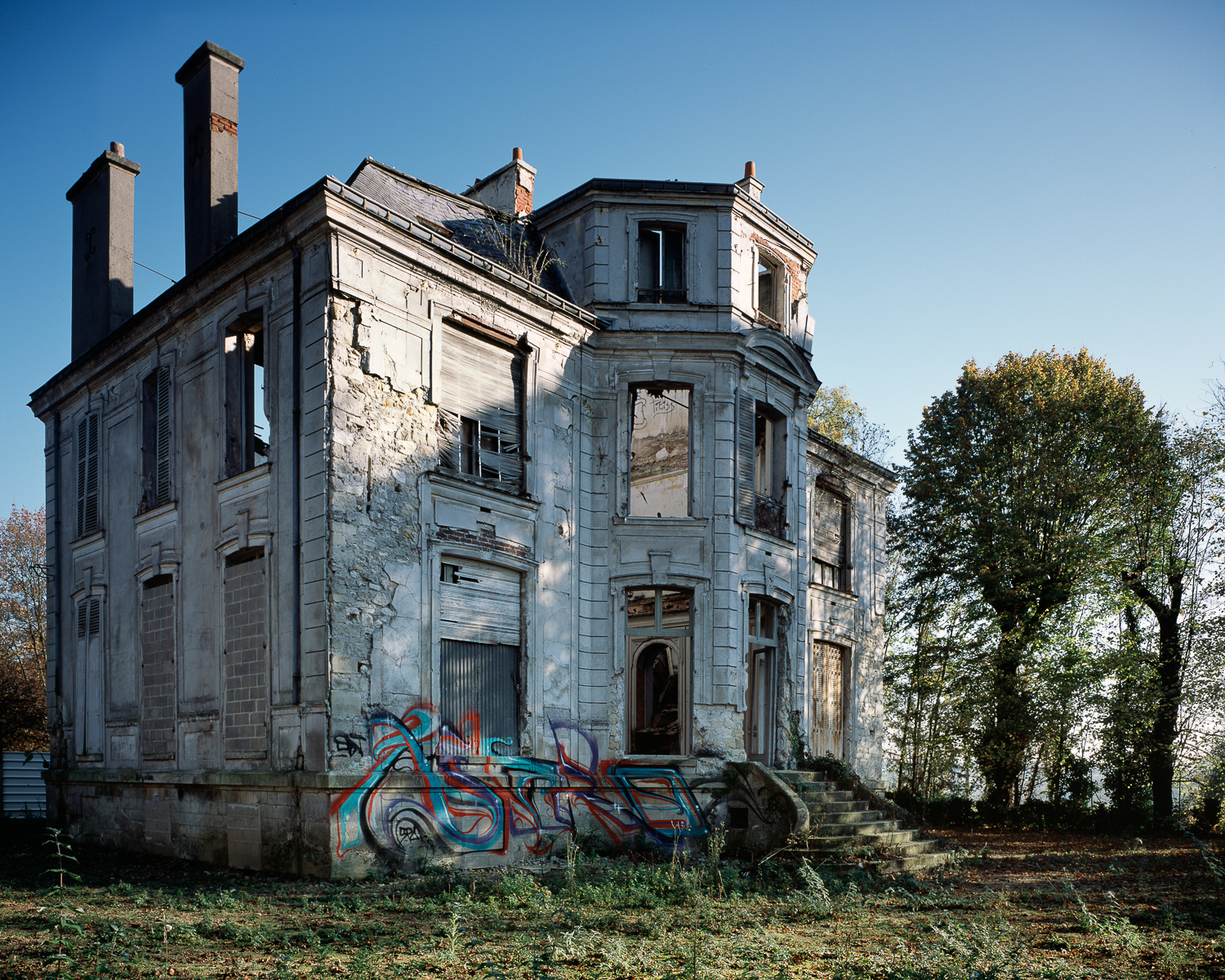
Some properties stood empty because their owners had left suddenly, unsettled by the noise or traumatised by the air-show crash. Others had been bought by the airport authority and then left to decay. Roof tiles slipped, windowpanes shattered, gardens became thickets. Traces of former lives – peeling wallpaper, rusting bicycles, faded shop signs – lingered in abandoned interiors. Photographers and urban explorers were irresistibly drawn to the atmosphere of arrested time.
Yet Goussainville-Vieux Pays has never been completely deserted. A few hundred residents chose to stay, accepting the noise in exchange for familiar streets and relatively low property prices. There is still a primary school on the main street, and at least one bookshop, Goussainlivres, continues to open its doors, its outdoor shelves sometimes photographed beneath the silent gaze of boarded-up neighbours.
This coexistence of life and abandonment gives the village its distinctive mood. On a weekday, you might hear children in the schoolyard and see locals chatting outside their homes while, only a few doors away, ivy climbs through broken windows and a grand nineteenth-century manor rots in an overgrown field.

Architecture frozen in place
Walking through the Vieux Pays today is like wandering through a catalogue of small-town French architecture spanning several centuries. Around the church are modest one- or two-storey stone houses with timber shutters and tiled roofs, some freshly painted, others mottled with damp and graffiti. Former shops still bear painted signs, such as the well-known “Au Paradis” façade, now closed and shuttered, which has become a minor local icon in photographs.
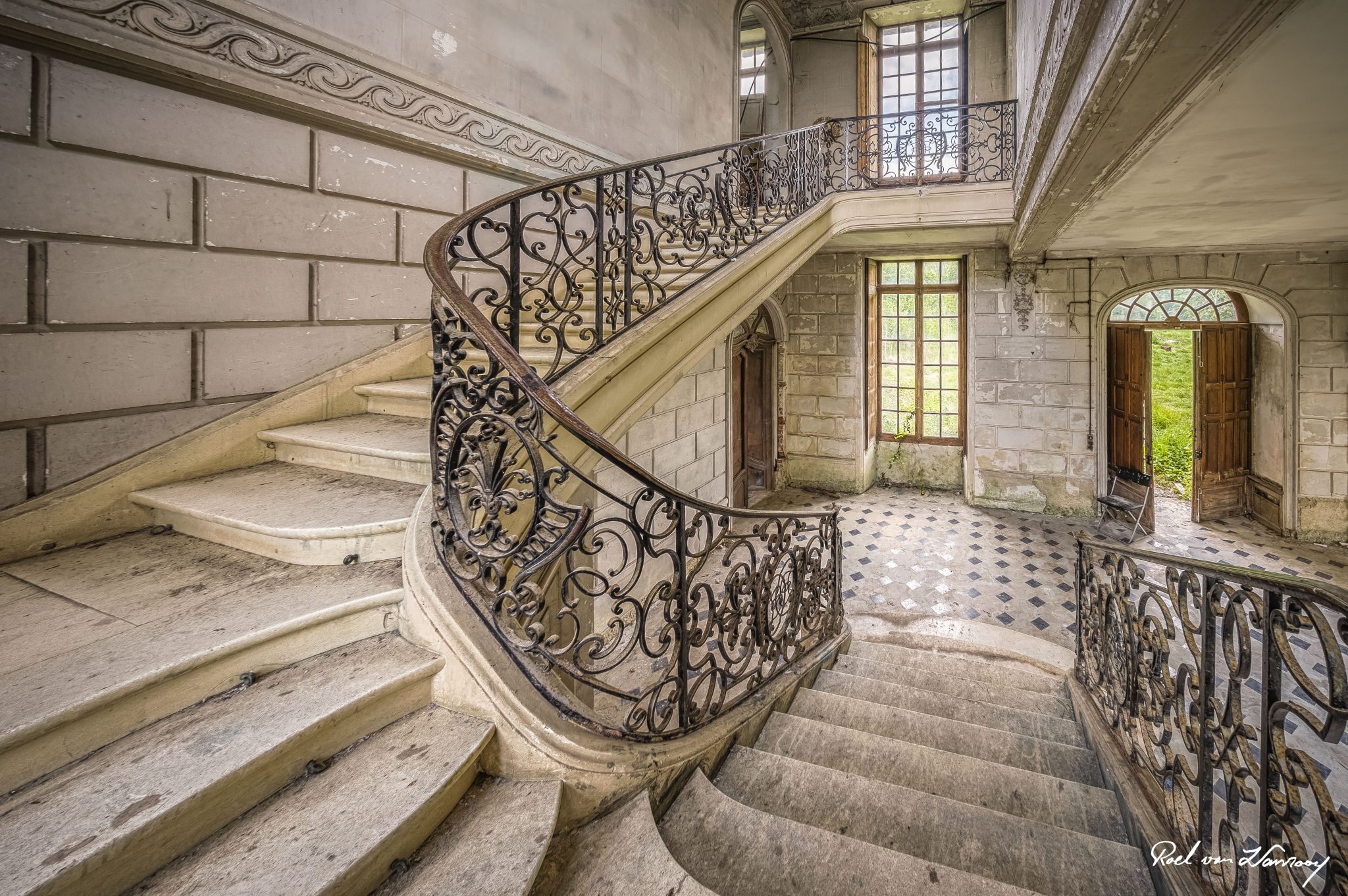
On the edge of the village stands the shell of an elegant mansion – once the pride of a local landowner, now reduced to a graffitied ruin with its roof gone and stairway open to the elements. In some shots a plane can be seen passing above the broken pediment, underlining the uneasy relationship between old stone and modern aviation.
Because many of these structures cannot be demolished easily due to heritage constraints, they form a kind of accidental open-air museum of decay. Some have been fenced off for safety; others remain accessible enough to tempt adventurous visitors, though local authorities and tourism bodies emphasise that entering unstable buildings is dangerous and prohibited. The result is a patchwork streetscape where renovation, neglect and slow reclamation by nature sit side by side.


Everyday life in a so-called ghost town
Despite its eerie reputation, the Vieux Pays is not a theme park or a film set. It is, first and foremost, a neighbourhood where people still live. That reality can surprise visitors seduced by online descriptions of a ghost village. Cars are parked along the streets; occasional deliveries arrive; locals walk dogs or carry shopping under the roar of jet engines.
For residents who remained, the decision was often a mixture of attachment, practicality and lack of alternatives. Some value the village’s atmosphere and community; others simply did not wish to uproot themselves or were unconvinced by compensation offers. Over the years, noise-insulation measures and changes in flight procedures have moderated – though not eliminated – some of the disturbance. Meanwhile, the wider commune of Goussainville has developed its own modern centre north of the old village, with apartment blocks, commercial areas and services more typical of a Parisian suburb.
The presence of photographers, journalists and curious day-trippers is a mixed blessing. On the one hand, it has drawn attention to the village’s plight and highlighted the need for coherent planning. On the other, constant “urbex” tourism can feel intrusive to people who simply wish to live in peace. Local tourism offices now promote guided or self-guided walks that encourage visitors to stay on public streets, respect private property and refrain from entering dangerous buildings.
Heritage, planning and uncertain futures
What, then, is to become of Goussainville-Vieux Pays? Over forty years after the airport opened, the village remains in a kind of limbo. The airport authority still owns numerous properties, many in poor condition, while the historic monument status of the church and the desire to preserve the traditional village fabric limit drastic redevelopment.
Occasional proposals have surfaced to renovate the old houses, encourage artists’ studios, or turn parts of the village into a heritage site celebrating the rural past of the Île-de-France. At the same time, the economic pressure of being under a major flight path and the logistical challenge of restoring decayed properties make large-scale transformation difficult. Some small-scale renovations have been undertaken by individual owners or the commune, hinting at the possibility of gentle rebirth rather than dramatic rescue.
The situation illustrates a broader tension found in many places around the world: how to protect historical environments and the rights of existing residents while accommodating large infrastructure projects deemed essential for national or regional development. In Goussainville, those questions are not abstract. They are etched into cracked plaster, empty window frames and the daily schedules of people who know exactly when the next aircraft will rumble overhead.

Visiting Goussainville-Vieux Pays today
For visitors interested in abandoned places, aviation history or the strange overlaps between past and present, Goussainville-Vieux Pays makes for a compelling, if slightly unsettling, excursion from Paris. Trains on the RER D line connect central Paris to Goussainville in under half an hour, and from the modern station it is a short walk to the old village streets.
Arriving on foot, you notice first the shift in soundscape: the regular surge of aircraft overhead, louder than in many parts of the capital itself. Then the visual details emerge: closed shutters, padlocked doors, wild gardens, the sudden elegance of the church, and the occasional lived-in house with flowerpots and lace curtains breaking the pattern of abandonment. It is important to remember that this is not a playground; houses, even derelict ones, belong to someone, and structures can be unstable. Remaining on public roads and paths, and treating the area with the respect you would give any residential district, is the surest way to explore without causing harm.
Conclusion: A village caught between sky and stone
Goussainville-Vieux Pays is more than a curiosity on the edge of an airport. It is a vivid case study in how modern infrastructure and catastrophic events can reshape a community’s destiny almost overnight. A farming village transformed into a suburb, then suddenly compromised by supersonic flight and the growth of global air travel, it now hangs in a delicate balance between decay and endurance.
The cracked walls and empty houses tell one story: of families who left, of lives interrupted by noise and fear. The still-standing church, the schoolyard, the bookshop and the remaining residents tell another: of attachment to place, of adaptation, and of the stubborn persistence of everyday life even under the thunder of jet engines.
In the end, the ghostly reputation of Goussainville-Vieux Pays may say as much about our own fascination with ruins as it does about the village itself. For those who walk its streets today, it offers a rare opportunity to see history, policy and human resilience written into the very fabric of a place – a village where the past is never quite gone, and the future remains unresolved, somewhere between the cobblestones underfoot and the aircraft passing overhead.