On a quiet fold of the Purbeck Hills, where chalk downland slips toward the sea and the breeze carries the tang of salt and gorse, lies Tyneham, a village with a unique and poignant story. Unlike most abandoned places that decline through economic hardship, natural disaster, or long attrition, Tyneham was emptied almost at once—its people told to leave their homes with the promise they would return after the war. They never did. Today the village stands as a remarkably preserved time capsule, its cottages roofless, its lanes hushed, its schoolroom and church kept like guardians of a memory that refuses to be erased. Tyneham’s story is not only about loss, but also about the strange afterlives places can have once ordinary life is abruptly suspended.

The Landscape and Early Roots
Tyneham sits in a sweep of chalk and clay between the ridge of Bindon Hill and Worbarrow Bay, a shoreline that belongs to the Jurassic Coast World Heritage Site. The geology here is restless and eloquent, with bands of rock folded like rumpled fabric and cliffs that tell of aeons of sea and subtropical lagoons. Human presence in this landscape reaches far back: barrows and ancient trackways dot the ridges, while the coastline bears the mark of centuries of fishing, quarrying, and smuggling. Tyneham itself emerged in the medieval period as a manorial settlement, elastic in size and fortune but anchored by agriculture, grazing, and the sea. For centuries the rhythm of life here followed the seasons—ploughing and planting, lambing and haymaking, mackerel runs and storm-watching, with the village church and manor house providing social and symbolic gravity.
A Manor, a Parish, and a Pattern of Life
By the nineteenth and early twentieth centuries, Tyneham had the familiar outline of an estate village. Tyneham House, set in its grounds, was the seat of the Bond family, landlords and local patrons. The village straggled along a lane toward the church of St Mary, with a rectory, farms, a smithy, and cottages cut from creamy Purbeck stone. Its school, opened in the late Victorian era, pulled children into a small classroom lit by tall windows, where slates and chalk and maps on rollers taught the world’s outline to those who might rarely leave the parish. The social fabric mixed paternalism and mutual dependence; villagers worked the estate lands or fished from the shingle of Worbarrow, while the manor contributed to church upkeep, seasonal festivities, and occasional repairs.
This was no idyll in the modern sense—rural life was hard, wages were low, and opportunities limited. But it was intimate, durable, and recognisable. The village had a soundscape that would have been ordinary anywhere in the English countryside: cattle at the gate, a dog barking, children reciting times tables, the ring of a hammer from the forge, the bell at St Mary’s calling the faithful and the hesitant alike. In winter the lanes could be muddy and the wind raw off the sea; in summer the hedgerows foamed with wild carrot and campion, and the air around the downs carried the tick of skylarks. It was an enclosed world that nonetheless felt complete.

The Evacuation of 1943
War, which had pressed at the edges of rural England for four years, finally broke upon Tyneham on 16 December 1943. The Ministry of War (later the Ministry of Defence) requisitioned the village and the surrounding land to expand the Lulworth Ranges in preparation for the Allied invasion of Europe. The demand was abrupt yet couched in the language of urgency and duty: leave now, for a greater good; you will return when victory is won. Families were given mere weeks to depart. They packed treasured possessions into carts and lorries, lifted photographs from mantelpieces, rolled up rugs, and tucked away letters. Some left notes on doors instructing future visitors to take care of the place. The most famous of these, pinned to the church door, asked that “Please treat the church and houses with care; we have given up our homes where many of us have lived for generations to help win the war and keep men free.”
More than two hundred residents left Tyneham and the neighbouring hamlets. They resettled where they could—near relatives, in rented rooms, in towns with work—imagining that by 1945 or soon after they would be back. The war did end, but the return never came. In the calculus of post-war defence, the ranges at Lulworth remained vital for gunnery training and armoured manoeuvres. Compensation was negotiated, pleas were made, but the village was retained for military use. What had been a temporary exile became permanent dispossession. Tyneham was left to the salt wind and the crash of artillery echoing over the hills.

A Village Suspended in Time
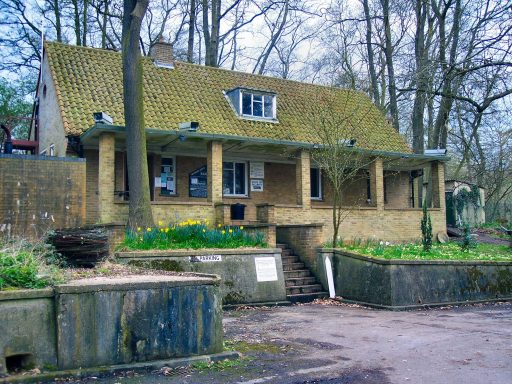
Because the land was closed to general development and still patrolled by live-firing exercises, Tyneham did not decay in the usual way of places cannibalised for building stone or cleared for new roads. It remained largely as it had been in 1943, but without its people. Roofs deteriorated and fell; brambles swallowed gardens; window frames rotted and dropped like eyelids. Yet the pattern of the village endured. The church of St Mary and the school were eventually stabilised and opened to the public when the ranges are not in use, becoming the principal spaces where the village’s story is told.
Walking Tyneham today, you move along lanes still edged by the ghosts of hedges and walls. Information boards identify the butcher’s shop, the post office, the cottages of families whose names still echo in parish registers and estate accounts. Where roofs remain safe or have been sympathetically reinstated, interiors hold curated displays: a kitchen table set with plates, a calendar pinned to the wall, a radio poised to carry the world in through its warm valves. Elsewhere, only a hearth and a jag of chimney survive in a tangle of nettles, the open sky turning rooms into courtyards.

St Mary’s Church: Memory in Stone and Light
St Mary’s, with its soft stone and modest tower, is the most intact building in the village and the most eloquent. Inside, wooden pews and memorial tablets tell of baptisms, marriages, harvest festivals, and long rectorates. The font is worn smooth by centuries of hands; fragments of stained glass loose their colour slowly into the pale light. Displays recount the evacuation and the families who left, not as a spectacle of tragedy, but as an intimate ledger of lives paused mid-sentence. The church remains a place of quiet and reflection, used from time to time for services, weddings, and acts of remembrance, stitching the present lightly to the village’s interrupted past.
The Schoolroom: The Last Lesson
The schoolhouse is perhaps the most moving space in Tyneham because it captures the precise mechanics of an ordinary day. Desks lined in ranks, inkwells like small black moons, wall maps showing an empire already shrinking, and slates that recall small hands and chalk dust. On the walls are photographs of pupils and teachers, names and faces matched with the cottages where they lived. It is easy to imagine the damper smell of coats drying by the stove, the muffled sound of recitation, the blur of a child’s daydream out through the high window. The school abruptly ceased, not because of scandal or inspection, but because the world required the village’s silence.


Tyneham House and the Wider Estate
Tyneham House, the manorial heart, suffered more than the church and school. Damaged by neglect and altered by military needs, it declined into partial ruin. Yet its footprint remains legible in the landscape: terraces, old garden walls, and the bones of an avenue hint at the estate’s former coherence. The Bond family’s history, and that of earlier owners, is woven through the fabric of the parish for centuries—intermarriages, endowments, and responsibilities that defined the relationship between manor, village, and land. The collapse of that triangle after 1943 left not only empty buildings but a disarticulated social structure, one that, like the house, survives only in traces.

War, Secrecy, and the Uses of Landscape
The military presence at Lulworth has given Tyneham a paradoxical preservation. On the one hand, the ranges are closed and sometimes hazardous, pocked by target hulks and scored by tracked vehicles; on the other, they have secured the parish from modern development. Much of the surrounding downland and coast has become an inadvertent sanctuary for wildlife. Chalk grassland species thrive, butterflies stitch the air along sunny banks, and the scrub shelters birds that dislike regular disturbance. The sea at Worbarrow Bay, when accessible, is remarkably clear, and the cliff flora shifts with the seasons in a display that feels increasingly rare in more manicured parts of the English coast.
The pattern of opening and closing, governed by firing schedules, has given Tyneham a curious rhythm. On permitted days, visitors drift through the village, reading names and peering into rooms. Then the gates close again, and the village resumes its long vigil. The oscillation between presence and absence amplifies the sense of a place existing between two states—neither wholly museum nor wholly ruin, neither fully public nor entirely lost.


Stories, Ethics, and the Question of Return
Tyneham has sparked debate for decades about the rights of communities, the demands of national defence, and the ethics of heritage. Some descendants of those evacuated preserve vivid memories of the old village and have campaigned for greater access or restitution. Others accept that the boundary between personal loss and collective security was drawn here, however painfully, and that the village’s present form has a kind of solemn fitness. The official stance has balanced safety, conservation, and remembrance: the church and school are maintained, information is provided, and visits are facilitated where possible, but the land remains a training ground.
There is also a subtler moral conversation encoded in Tyneham. What is a village without villagers? Can a place stand in for a community, or is the community the only meaning the place ever had? As you pass a doorway that once held a threshold worn by a household’s comings and goings, you begin to see how quickly buildings lose their human scale when they lose their people. Yet the careful curation within the school and church, the lists of names and family trees, reintroduce the personal. They insist that the village’s emptiness is not a void but a memorial.
Tyneham in the Imagination
Over time, Tyneham has drawn artists, writers, and photographers who are compelled by its suspended condition. The textures of stone and lath, the way grass bleeds through floorboards, the way the sea’s voice seems louder in the absence of domestic noise—all these have fed a modest but persistent cultural afterlife. Tyneham appears in documentaries and travel writing as both a caution and a curiosity, a reminder that modern nations make hard choices and that those choices land somewhere tangible, on a map, where lives are uprooted. It is often bracketed with other requisitioned places, such as the villages swallowed by reservoirs or the training grounds on Salisbury Plain, but Tyneham’s combination of coastal beauty, intact plan form, and accessible interiors gives it a particular resonance.

Visiting and the Etiquette of Ruins
When the ranges are open, visitors can reach Tyneham by narrow lanes that wind through farmland and heath. The approach is itself an education in Dorset geography, tight hedgebanks and sudden vistas, chalk dust on the verges. Arriving in the village, the etiquette is simple: tread lightly, read, listen, and take your time. It is tempting to map one’s own stories onto the place, but the village offers a more generous bargain if you let it speak in its own register. In the church and school you will find exhibits that restore a human temperature to the rooms. Outside, the outlines of cottages and gardens guide you through a settlement that still knows exactly what it is, despite its long sleep.
For those who walk on to Worbarrow Bay, the route follows the old road past hedgerows where campion and ivy tussle for shade. The sea opens suddenly, the beach arcs between headlands, and the cliffs lean back like seated giants. It is a beautiful, slightly stern coast, the sort that looks best under a high, shifting sky. Standing there, it is easy to understand why Tyneham’s loss is so keenly felt, and also why its endurance as a place of memory seems just.

Conclusion: Silence, Service, and the Weight of Place
Tyneham is not merely an abandoned village; it is a layered story about service and sacrifice, about promises made under duress, and about the slow work of remembering. Time has not erased it. Instead, time has polished its edges, showing both the fragility of domestic life and the stubbornness of place. The cottages remain as husks, yes, but their names survive; the church with its patient nave still gathers thoughts and prayers; the schoolroom keeps its last lesson in a perpetual present tense. All around, the Dorset landscape continues its ancient business of growth and weathering, with the sea underwriting everything with its endless punctuation.
To walk through Tyneham is to feel how history is not a straight road but a braid of choices, contingencies, and consequences. The village’s silence is not empty. It is full of voices, if you know how to hear them: the echo of a bell, the scrape of a chair on a flagstone floor, the hush of families leaving with what they could carry, the murmured promise that proved, in the end, to be a farewell. In that sense, Tyneham has not been lost. It has become something else—a careful remembrance held in stone and air, set within one of England’s most striking coastal landscapes, asking each visitor to consider what it means to give up a home and what it means to keep a place alive.